The Reformation Loop | Bitcoin Is Not Finished — Ep. 3
🎧 LISTEN TO THIS ESSAY
In the last episode, we saw how GPS — a technology that hadn’t changed in fifty years — exploded when the iPhone gave its signals somewhere to land. But there’s a part of that story we didn’t explore. When GPS met the smartphone and created Uber, it didn’t just build something new. It destroyed something old.
In 2013, a New York City taxi medallion — the metal plate that gives you the legal right to operate a yellow cab — sold for $1.3 million. One plate. That price existed because the city capped the number of medallions, creating an artificial monopoly. If you wanted to drive a taxi, you either owned a medallion or you worked for someone who did. The gatekeepers controlled access to an entire industry.
By 2023, that same medallion was worth $140,000. A 90% collapse.
What happened? Uber happened. GPS plus a smartphone plus an app meant that anyone with a car could offer rides. The medallion — the permission slip — became irrelevant. The monopoly didn’t die because someone argued it should. It died because millions of people used an alternative, and the regulators couldn’t put the genie back in the bottle.
But here’s what’s interesting. The same technology was available everywhere. GPS satellites don’t care about national borders. Smartphones are global. And yet, the result was completely different depending on where you looked.
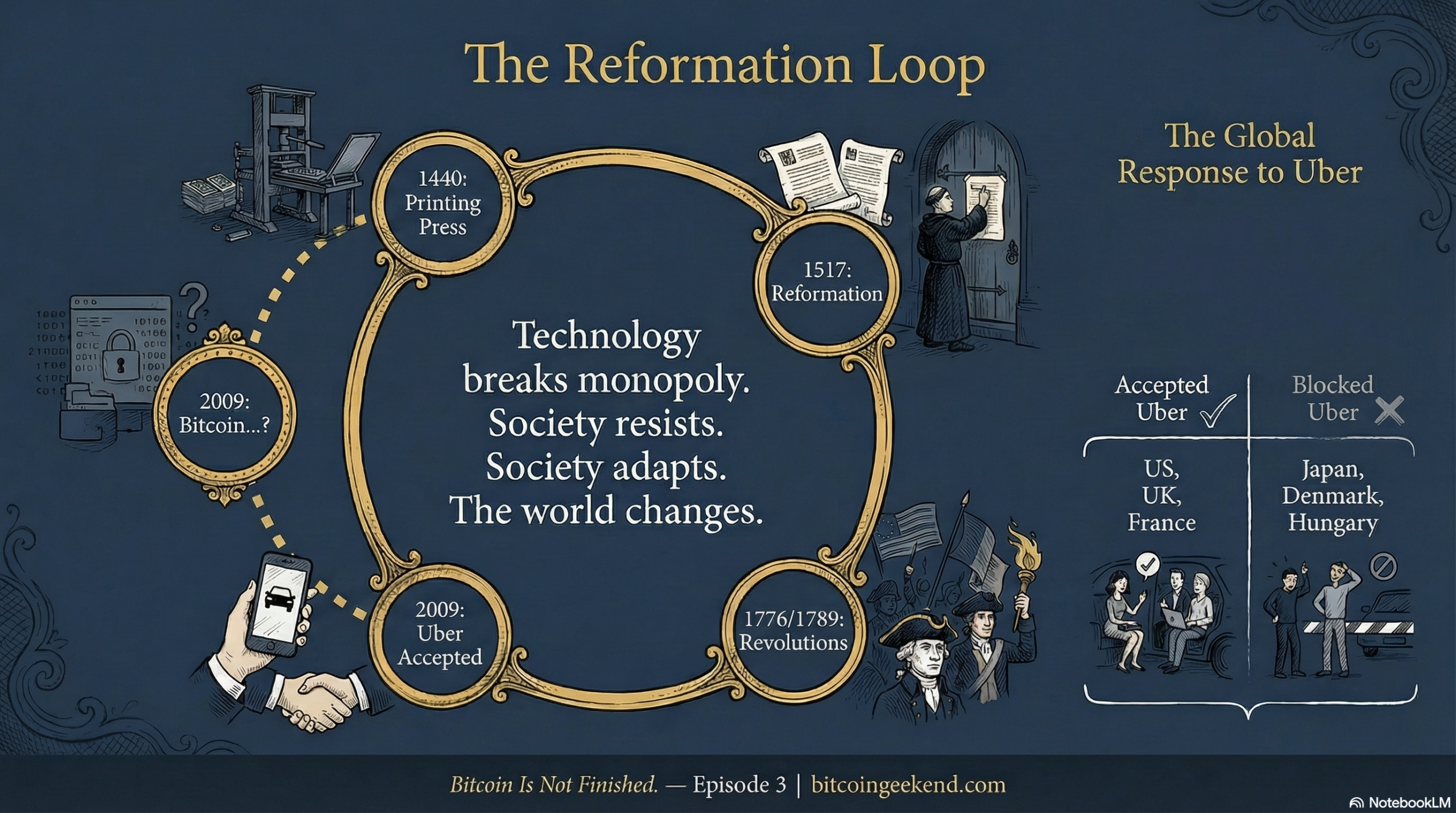
In the United States, Uber won. It was messy — lawsuits, protests, city-by-city battles — but in the end, the convenience won. In the United Kingdom, London banned Uber twice, and Uber came back both times. In France, taxi drivers rioted in the streets, and the government banned UberPop. But Uber survived in a different form.
In Japan, Uber exists, but it’s been defanged. Japanese law requires all ride-share drivers to operate under a licensed taxi company. The times and areas where they can operate are restricted. The fares are set at taxi-level prices. The taxi industry sits in the middle as a gatekeeper — exactly the structure Uber was supposed to eliminate.
In Denmark, the government required fare meters and seat sensors. Uber left the country rather than comply. In Hungary, parliament passed a law allowing authorities to block “illegal dispatch services” from the internet. Uber shut down.
Same satellites. Same smartphones. Same app. Completely different outcomes.
Why?
I spent some time looking at this, and a pattern emerged that I didn’t expect. The countries that accepted Uber — that allowed a new technology to dismantle an old monopoly — tend to be countries with a specific historical experience. They are countries where citizens fought to take power away from centralized authority.
The United States was founded on the rejection of a king. The American Revolution was, at its core, a declaration that no single authority has the right to control the lives of individuals. That DNA runs through everything — including the instinct that if a better service exists, the government shouldn’t be the one stopping you from using it.
The United Kingdom went through its own version. Henry VIII broke from the Pope. The Puritans overthrew the king. The English Civil War, the Glorious Revolution — centuries of citizens pushing back against centralized power.
France took the most violent path. The French Revolution didn’t just remove a king. It dismantled the entire structure of aristocratic and clerical privilege in a single generation.
Now compare that to countries where Uber was blocked or neutered.
Japan has never had a citizen-led revolution. The Meiji Restoration was a top-down transformation — one group of elites replacing another. The population didn’t rise up and seize rights from an authority. There is no cultural muscle memory for saying “this monopoly is illegitimate, and we’re going to break it.”
And here’s where the loop closes — and where it gets strange.
What made the American Revolution possible? What made the French Revolution possible? What gave ordinary citizens the idea that they could challenge the Church, the monarchy, the entire structure of power?
The printing press.
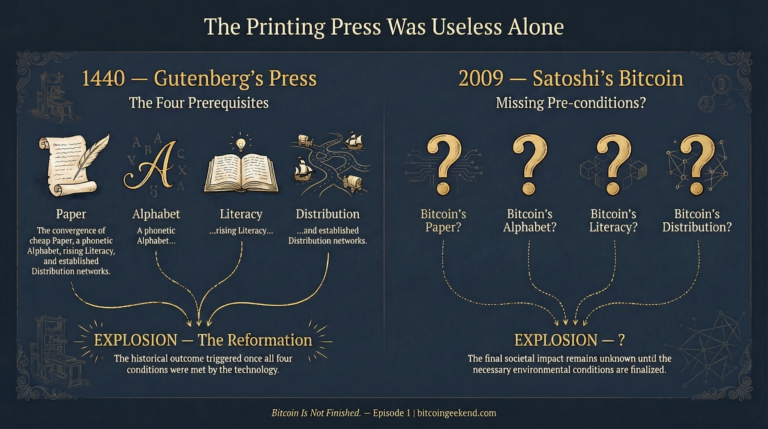
Gutenberg’s press made it possible for Martin Luther to distribute his 95 Theses across Europe in weeks. Before the press, the Church had a monopoly on scripture. Ordinary people couldn’t read the Bible — they had to trust the priest’s interpretation. The printing press broke that monopoly. It put information directly into the hands of individuals. And once people could read for themselves, they started asking questions that the Church couldn’t answer.
The Reformation led to wars of religion, which led to demands for individual rights, which led to the Enlightenment, which led to the American and French Revolutions, which created societies where citizens expect the right to choose — including the right to choose Uber over a taxi monopoly, four hundred years later.
The printing press → the Reformation → individual rights → nations that accept disruption.
This is a five-hundred-year butterfly effect. And it’s still playing out.
A technology created to print Bibles ended up determining, half a millennium later, which countries would allow a smartphone app to disrupt their taxi industry. Gutenberg could not have imagined Uber. Luther could not have imagined GPS. The American founders could not have imagined a world where the principles they fought for would manifest as an argument about ride-sharing apps.
Nobody planned this chain of events. Each link was built by people who had no idea what they were setting in motion.
Now, stand back and look at Bitcoin through this lens.
Bitcoin is a technology that removes the gatekeeper from financial transactions. No bank needed. No government approval needed. No medallion. Just a protocol that anyone can use, anywhere, without asking permission.
The countries that resist Uber are the same countries that resist Bitcoin — because the underlying question is identical. Will you allow a new technology to bypass the existing power structure? Your answer depends not on the technology itself, but on whether your society has the historical experience of successfully challenging centralized authority.
And the technology that started that chain of experience — the very first link — was a printing press in a workshop in Mainz, in 1440.
So when someone asks me whether Bitcoin will succeed, I don’t look at hash rates or ETF inflows. I look at a much longer arc. I look at whether the same pattern that has repeated for five hundred years — technology breaks monopoly, society resists, society adapts, the world changes — is playing out again.
I believe it is. And unlike Gutenberg’s time, where conditions took four centuries to converge, the conditions Bitcoin needs are assembling at extraordinary speed. Right now. In front of us. The “paper” and “alphabet” and “literacy” that Bitcoin has been waiting for — they’re not in some distant future. They’re expanding rapidly, and most people haven’t connected the dots yet.
What are they? That’s what we’ll explore in the next episode. And when you see it, I think you’ll agree — this is massive.
Bitcoin is not finished.
Bitcoin Is Not Finished is a series exploring what Bitcoin might become — not through price charts or market analysis, but through the patterns humans have repeated across 6,000 years of technological history. New episodes publish twice weekly.
Also available on Apple Podcasts and YouTube.