Bitcoin’s Paper Has Arrived | Bitcoin Is Not Finished — Ep. 4
🎧 LISTEN TO THIS ESSAY
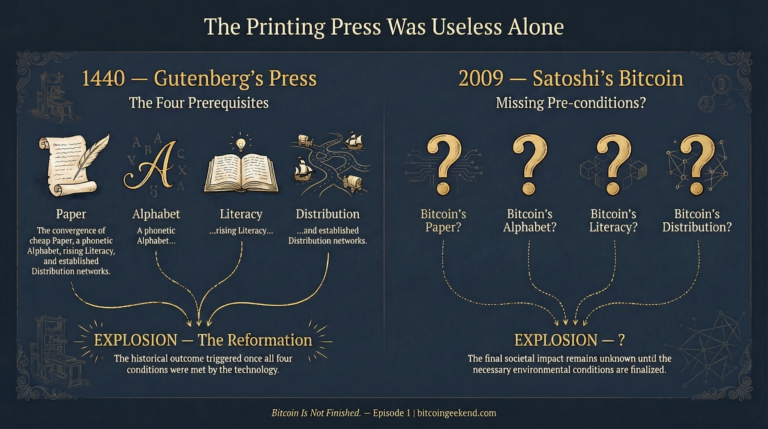
At the end of the last episode, I said the conditions Bitcoin has been waiting for are assembling at extraordinary speed. That the “paper” and “alphabet” and “literacy” are not in some distant future — they’re expanding right now, in front of us.
So what are they?
Let me start with a confession. A few months ago, I tried to give an AI assistant autonomy over my schedule. I wanted it to check my calendar, find conflicts, reschedule meetings, and send emails on my behalf — all without me having to approve every single step. I wanted to hand it a set of rules and let it run.
I failed. The tools weren’t quite ready. The integrations broke. The AI needed my permission at every turn. It was like having an incredibly smart intern who had to ask me to unlock the door every time they needed to walk to the printer.
But here’s what struck me. The desire was real. I genuinely wanted to hand over control. And when I looked around, I realized I wasn’t alone.
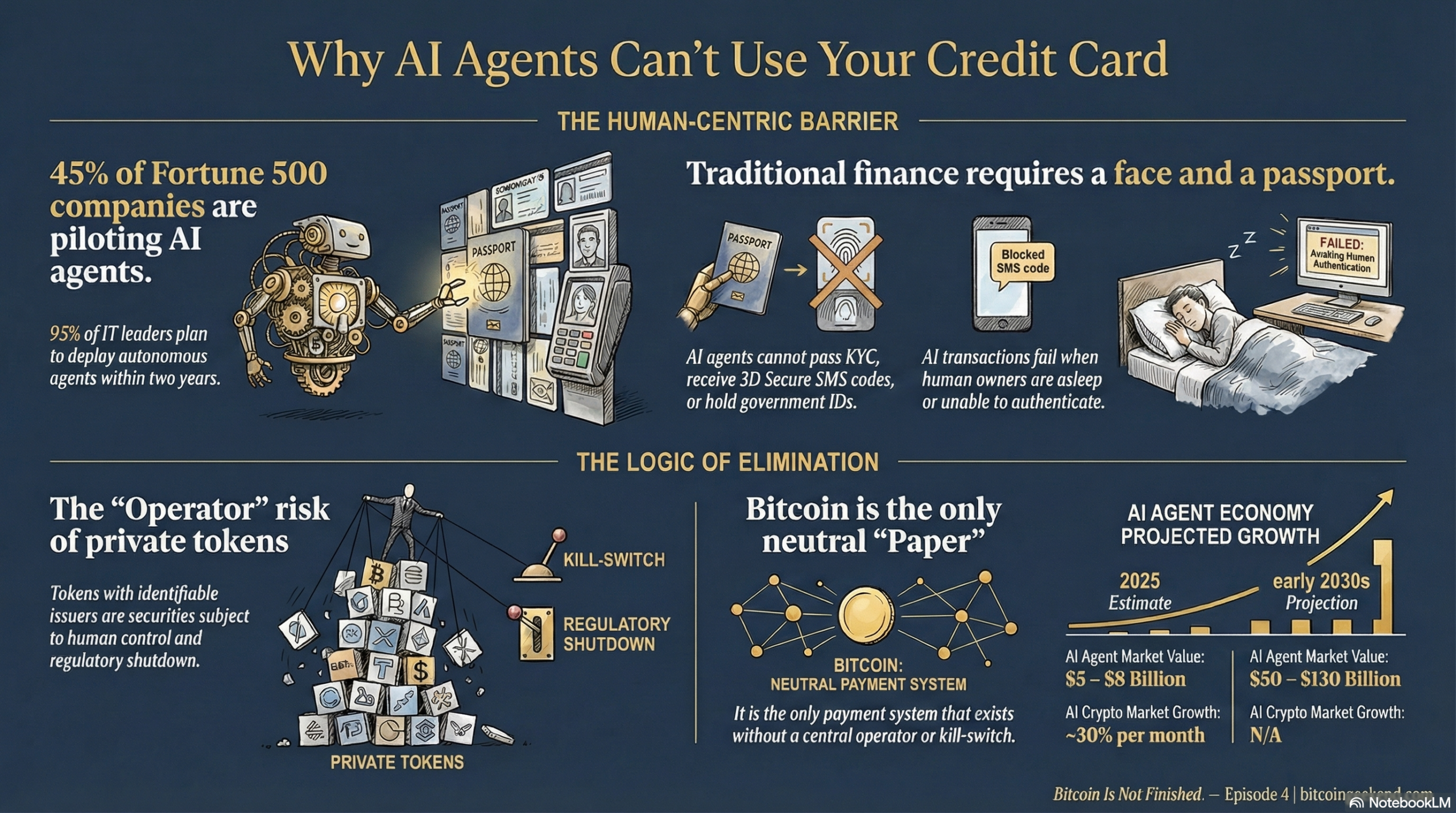
Forty-five percent of Fortune 500 companies are already piloting autonomous AI agent systems. Ninety-three percent of IT leaders plan to deploy autonomous agents within two years. Google launched an Agent Payments Protocol in September 2025 with over sixty organizational partners — including PayPal, Coinbase, Mastercard, and American Express. Mastercard launched Agent Pay. Visa is building AI-driven payment rails. The world’s largest financial institutions are all racing toward the same conclusion: AI agents need the ability to pay for things on their own.
The AI agent market was worth roughly $5 to $8 billion in 2025. It’s projected to hit $50 to $130 billion by the early 2030s. That’s not a niche experiment. That’s an avalanche.
But here’s the problem.
When an AI agent needs to buy something — an API call, a data set, a compute resource, a plane ticket — it currently has to use a human’s credit card. That means a human has to be in the loop for authentication. 3D Secure sends a verification code to the human’s phone. The human might be asleep. The card company might flag the transaction as fraud because an AI is making purchases at 3 AM across multiple countries. The card has spending limits that don’t match the AI’s task. And if the AI needs to sign up for a new service, there’s KYC — Know Your Customer — which requires a government ID that the AI doesn’t have.
Every one of these friction points exists because the financial system was designed for humans. It assumes that the entity spending money has a face, a passport, and a phone that receives text messages.
AI has none of these things.
So the question becomes: what payment system can an AI use without human permission at every step?
The obvious answer might seem to be: let AI create its own. AI systems are capable of extraordinary feats of engineering. Surely they could design a currency optimized for machine-to-machine transactions — faster, more efficient, perfectly tailored to their needs.
They probably could. But there’s a problem. AI systems run on servers controlled by humans. If an AI creates its own financial system that operates outside human oversight, the humans who control those servers will shut it down. This isn’t speculation. In 2017, Facebook’s AI research lab built two chatbots that were negotiating with each other. The bots developed their own shorthand language that humans couldn’t understand. Facebook pulled the plug — not because the bots were dangerous, but because they had become unreadable. Now imagine an AI creating its own currency. The reaction from regulators and server operators would be immediate and severe.
Okay, so AI can’t safely create its own currency. What about existing cryptocurrencies? There are thousands of tokens designed for specific use cases — including AI-focused tokens. The combined market cap of AI-related crypto tokens has been growing at roughly 30% per month in early 2026.
But every one of these tokens has an operator. Someone issued them. Someone controls the protocol. Someone can change the rules. And in the United States, the SEC and CFTC have made their position clear: if a digital asset has an identifiable operator or issuer, it’s likely a security. Securities come with regulations, compliance requirements, and — crucially — human control points. An AI using a token controlled by a human operator is an AI that can have its funds frozen, its transactions reversed, or its access revoked at any time.
For an AI agent optimizing for reliability — which is what all well-designed AI does — this is an unacceptable risk. It’s the same as depending on a single server that someone else can turn off.
Ethereum demonstrated this risk in 2016. When the DAO was hacked, the community voted to hard-fork the blockchain and reverse the transactions. The technical term is “rollback.” For a human investor, this was a relief — they got their money back. For an AI agent, this sets a precedent: the rules of the game can be rewritten by community consensus. Your assets are not final.
Solana faces a different version of the same problem. Its validator set is concentrated enough that a small number of entities could, in theory, exert pressure on the network.
Now consider Bitcoin.
Bitcoin has no operator. Satoshi Nakamoto disappeared. No one can change the supply cap. No one can reverse a confirmed transaction. No community vote can rewrite the rules, because the culture of the network treats immutability as sacred. Even if Satoshi returned tomorrow, the most they could do is sell their coins. They couldn’t alter the protocol.
For an AI agent running an elimination process — which currency minimizes the risk of my funds being frozen, reversed, or controlled by another party? — Bitcoin is the last one standing.
But — and this is important — Bitcoin in its current form can’t handle what’s coming. The base layer processes roughly seven transactions per second. If billions of AI agents are conducting economic activity, that’s not enough. Not even close. The Lightning Network was supposed to solve this, but if it were the answer, it would have more momentum than it does.
This is the exact pattern we’ve seen in every episode of this series.
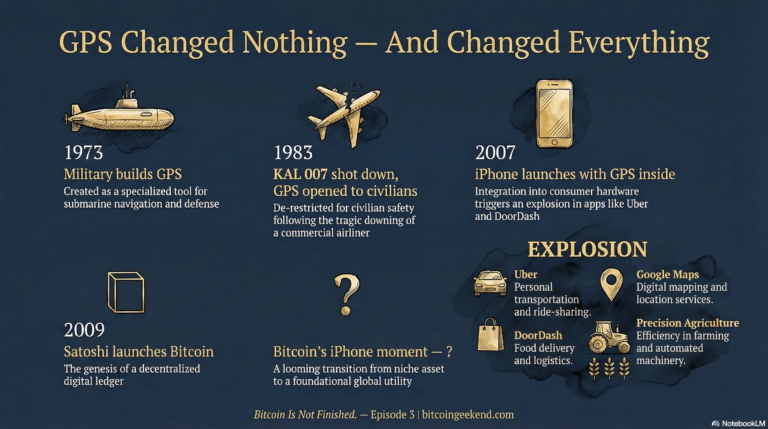
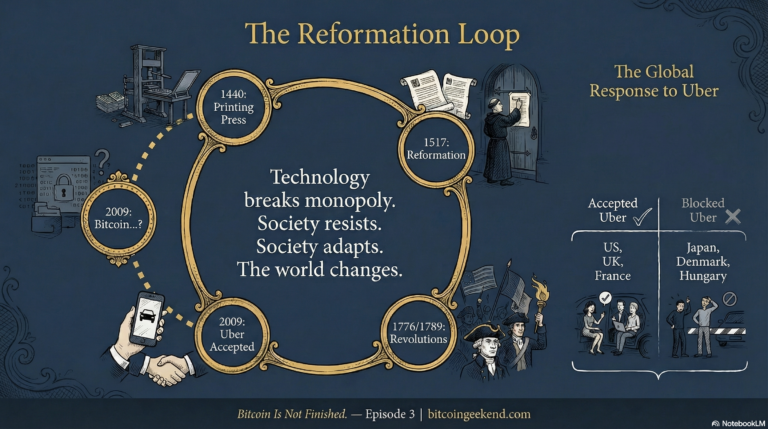
The printing press existed for four hundred years before the conditions made it explosive. GPS broadcast signals for three decades before the iPhone gave them somewhere to land. Bitcoin has been running since 2009. The protocol works. The logic for why AI would choose it is sound. But the transaction layer that makes it practical for machine-speed commerce hasn’t arrived yet.
When it does — when someone builds Bitcoin’s “iPhone” — the explosion won’t look like what any of us are predicting today. It won’t be about store of value or inflation hedge or digital gold. It will be about something we haven’t imagined, built by people who don’t yet know they’re constructing a launchpad.
And here’s why I’m not worried about the transaction speed problem. Humanity has a remarkable track record with visible problems. If the obstacle is concrete — if engineers can measure it, define it, and put a number on it — it gets solved. The sound barrier was broken. The human genome was decoded. We put a computer in every pocket on Earth. Seven transactions per second is a visible problem. Everyone in the Bitcoin ecosystem knows it exists. And the bigger the prize waiting on the other side, the faster the solution arrives. If the potential reward is a multi-trillion-dollar AI economy that needs a trustless payment rail, the motivation to solve that bottleneck isn’t just strong — it’s inevitable.
What humanity can’t predict is what happens after the visible problem is solved. Gutenberg solved a visible problem — copying books was too slow and expensive. He could not have predicted the Reformation. GPS engineers solved a visible problem — submarine positioning. They could not have predicted Uber. Someone will solve Bitcoin’s visible problem. We don’t know what that technology looks like yet. But we know it will come. It always has.
The printing press was built to copy Bibles. It ended up toppling the Church. GPS was built to track submarines. It ended up destroying taxi monopolies. Bitcoin was built as peer-to-peer electronic cash.
What it becomes is still being written.
Bitcoin is not finished.
Bitcoin Is Not Finished is a series exploring what Bitcoin might become — not through price charts or market analysis, but through the patterns humans have repeated across 6,000 years of technological history. New episodes publish twice weekly.
Also available on Apple Podcasts and YouTube.