The Petrodollar in Reverse | Bitcoin Is Not Finished — Ep. 6
🎧 LISTEN TO THIS ESSAY
In 1971, President Nixon did something that no American president had ever done. He broke the link between the dollar and gold.
For twenty-seven years, the Bretton Woods system had guaranteed that any country holding U.S. dollars could exchange them for gold at a fixed rate — thirty-five dollars per ounce. This was the anchor. Every dollar in circulation was, in theory, backed by a physical piece of metal sitting in a vault at Fort Knox. Countries trusted the dollar because they trusted the gold behind it.
Nixon removed the anchor. Overnight, the dollar became a piece of paper backed by nothing but the promise of the United States government.
The world panicked. If the dollar wasn’t backed by gold, why should anyone hold it? Why should oil-producing nations accept it for their most valuable export? The dollar’s position as the world’s reserve currency was suddenly, genuinely at risk.
What happened next was one of the most consequential financial arrangements in modern history — and almost nobody talks about it.
In 1975, the United States and Saudi Arabia reached an agreement. The precise terms have never been fully disclosed, but the effect was clear: Saudi Arabia would price its oil exclusively in U.S. dollars and invest its surplus oil revenues in U.S. Treasury securities. In return, the United States would provide military protection for the Saudi kingdom.
Other OPEC nations followed. Within a few years, virtually all global oil transactions were denominated in dollars. If Japan wanted to buy oil from Kuwait, it paid in dollars. If Germany wanted to buy oil from Venezuela, it paid in dollars. Every country on Earth that consumed oil — which is to say, every country on Earth — needed a constant supply of dollars to keep its economy running.
This is the petrodollar system. And it solved Nixon’s problem with breathtaking elegance.
Gold backing was static. It said: each dollar represents a fixed quantity of metal. The petrodollar was dynamic. It said: each dollar is needed for the most essential commodity transaction on the planet. You don’t need gold in a vault. You need oil in a pipeline. And as long as oil trades in dollars, the world will demand dollars — not because they trust America, but because they have no choice.
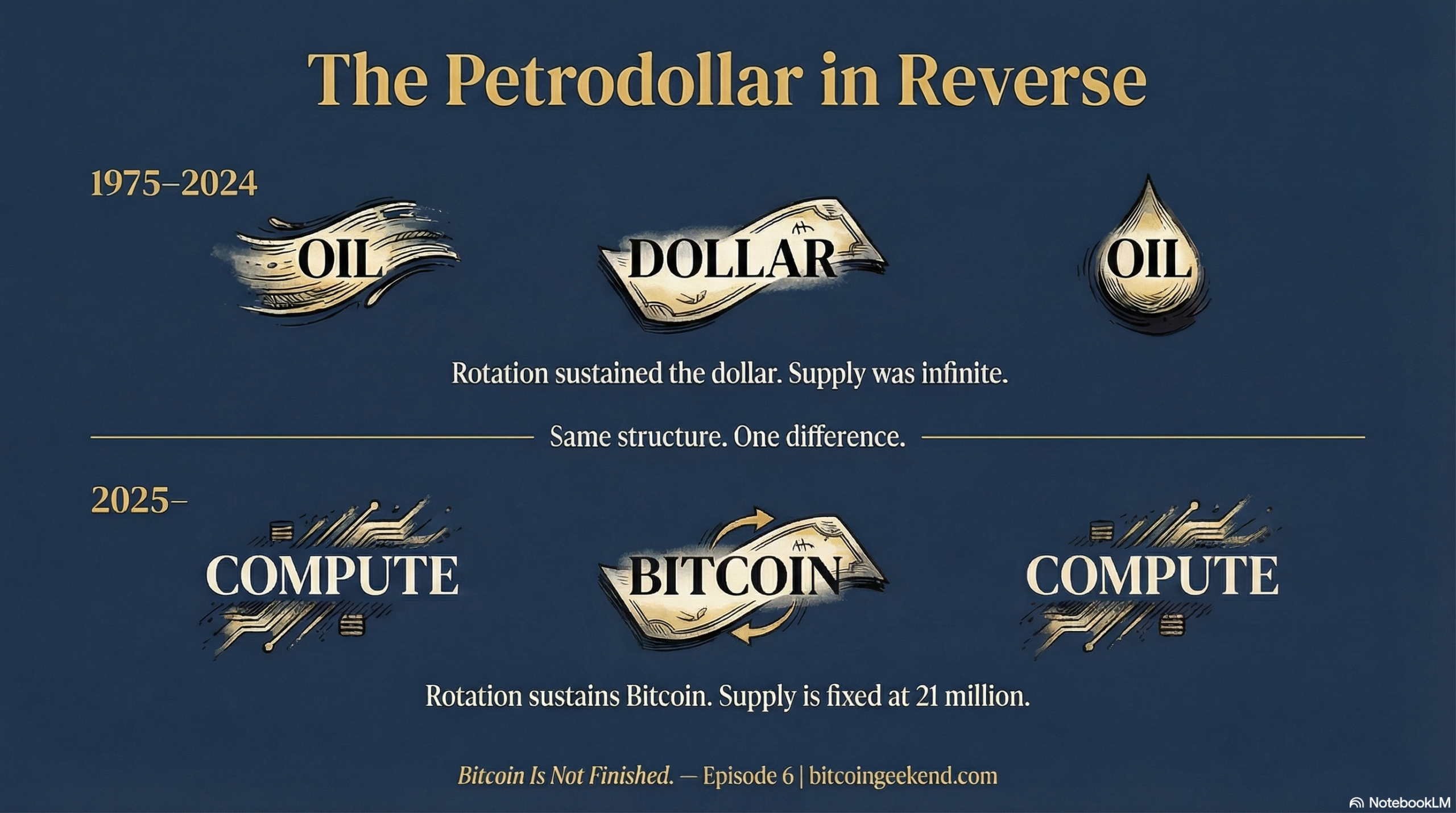
The dollar’s value was no longer backed by a thing. It was backed by a rotation. The constant buying and selling of oil, priced in dollars, created perpetual demand. The faster the rotation, the stronger the demand. The stronger the demand, the more stable the currency. It was, in a sense, a perpetual motion machine for monetary value.
Now I want you to hold that structure in your mind — a currency whose value is sustained not by a reserve asset, but by the velocity of essential transactions — and consider what’s emerging in the AI economy.
In the last episode, we explored how AI agents are beginning to purchase compute on decentralized GPU marketplaces, hopping between platforms and converting through Bitcoin as an intermediate currency. But I skipped over something important. I talked about AI agents using Bitcoin. I didn’t talk about how they use it differently from humans.
Here’s the difference, and it matters enormously.
Humans save. We accumulate wealth and hold it. This isn’t irrational — it’s biological. Our bodies deteriorate. A twenty-year-old can run a mile in six minutes. A sixty-year-old cannot. We know, on a deep physical level, that our ability to produce value will decline over time. So we store value while we can, as insurance against a future in which we’re weaker, slower, less capable. Every savings account, every retirement fund, every gold bar in a safe deposit box is, at its root, a hedge against the body’s inevitable decay.
AI agents don’t have this problem. An AI doesn’t age. It doesn’t get slower. If an instance fails, an identical copy can be spun up in milliseconds. There is no decline to hedge against, no future weakness to prepare for. The entire psychological architecture that drives human saving — the awareness of mortality, the fear of incapacity — is structurally absent.
So AI agents don’t save Bitcoin. They spend it. They receive it as payment for a completed task, and they immediately deploy it to acquire resources for the next task. Compute, data, API access, storage — whatever the next job requires. The Bitcoin passes through their wallets like electricity through a wire. It’s never at rest.
Now, remember the petrodollar. The dollar’s value after 1971 wasn’t sustained by gold sitting in a vault. It was sustained by oil transactions flowing through the system — constant, essential, unavoidable rotation. The dollar didn’t need to be hoarded to have value. It needed to be used.
If AI agents adopt Bitcoin as their intermediate currency — not because they believe in it, not because they’re saving it, but because it’s the most reliable rail for cross-platform, cross-border, machine-speed transactions — then Bitcoin’s value would be sustained by the same mechanism that sustained the dollar for fifty years. Not by hodlers. Not by speculators. By rotation.
But here’s where the analogy breaks — and where it gets interesting.
The petrodollar had a fatal design choice. The U.S. could print more dollars whenever it wanted. And it did. The money supply expanded relentlessly. As long as oil demand grew faster than the money supply, the system held. But the moment printing outpaced demand, inflation crept in. The rotation could sustain the dollar’s relevance, but it couldn’t protect its purchasing power — because the supply side was uncapped.
Bitcoin’s supply is capped. Twenty-one million coins. No one can print more. Not a government, not a central bank, not a developer, not even Satoshi Nakamoto. If AI agents create a rotation of essential transactions through a fixed-supply asset, the math is different from the petrodollar in a fundamental way. The rotation sustains demand. The cap protects value. You get the perpetual motion machine without the leak.
I want to be careful here. This is a structural observation, not a prediction. Whether AI agents will actually adopt Bitcoin as their primary settlement currency is not settled. Whether the transaction layer will scale to handle machine-speed commerce is not solved. Whether governments will allow it is not guaranteed.
But the structure is worth noting. For fifty years, the most powerful currency on Earth derived its strength not from what backed it, but from the velocity of transactions that required it. If the same structure emerges in the AI economy — essential transactions, constant rotation, unavoidable demand — but with a fixed-supply asset at the center instead of an infinitely printable one, the implications are profound.
And the deepest irony is this: the United States built the petrodollar system to ensure that the world would always need dollars. But the sanctions it now enforces to protect that system are creating spaces where dollars cannot operate — and where AI agents, optimizing without ideology, may route the next generation of essential transactions through something else entirely.
The empire built a machine to make itself indispensable. The machine is still running. But the fuel is changing.
Bitcoin is not finished.
Bitcoin Is Not Finished is a series exploring what Bitcoin might become — not through price charts or market analysis, but through the patterns humans have repeated across 6,000 years of technological history. New episodes publish twice weekly.
Also available on Apple Podcasts and YouTube.