Bitcoin Has Never Held Still
What Bitcoin moves with keeps changing. That shift — not any single link — is the most important thing the data says about it.
So what is Bitcoin, really?
Digital gold? A risk asset? An inflation hedge? A safe haven? A bubble that hasn’t popped yet?
Ask around and you’ll get every one of those answers — usually from people who sound equally sure.
They can’t all be right.
And if Bitcoin has always felt like the one thing you could never pin down, here’s some relief. That isn’t you failing to understand it. It’s the most accurate reaction in the room.
Here’s the answer, the one hiding under fourteen years of arguing.
Bitcoin keeps changing what it is. Not because it’s broken or fake — because it’s young.
What it moves with, what moves it, what people measure it against: all of it shifts from one era to the next.
And that shifting — the thing everyone calls Bitcoin’s worst flaw — is the clearest sign that it’s a new asset, still growing into its own skin.
Let me show you. Start with the strangest spring Bitcoin ever had.
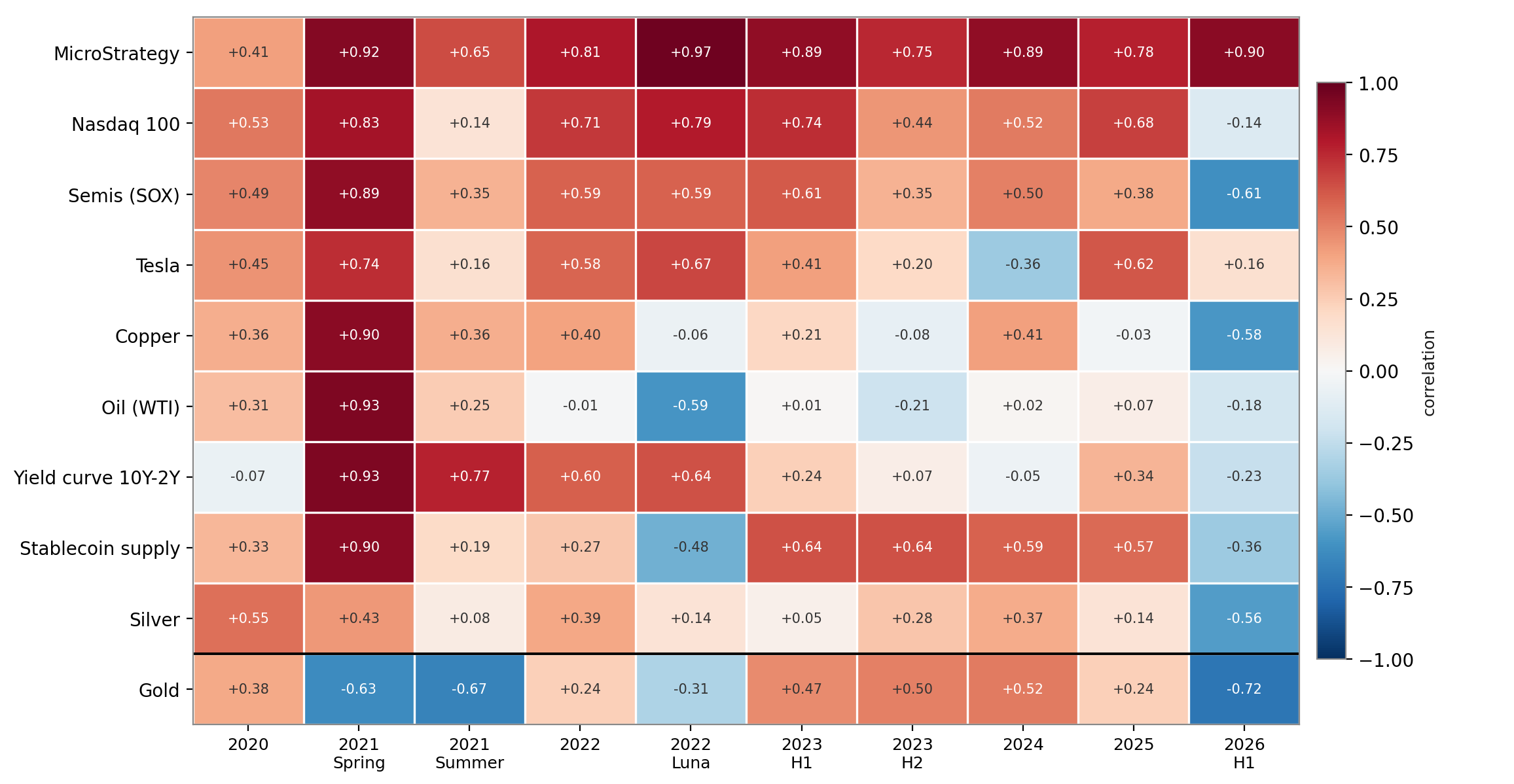
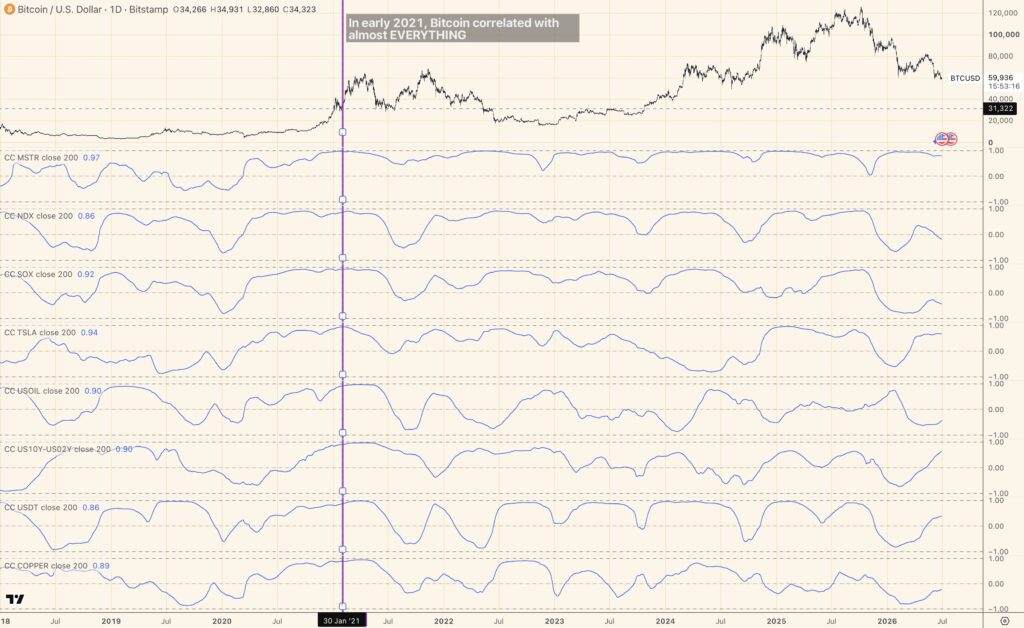
In early 2021, Bitcoin moved with almost everything at once.
Bonds. Oil. Copper. Chip stocks. The Nasdaq. Even Tesla.
All of it rising together — all of it tracking Bitcoin above +0.9.
For a few months, you could’ve called Bitcoin a bond, a barrel of oil, or a tech stock — and been right every time.
One asset refused to join.
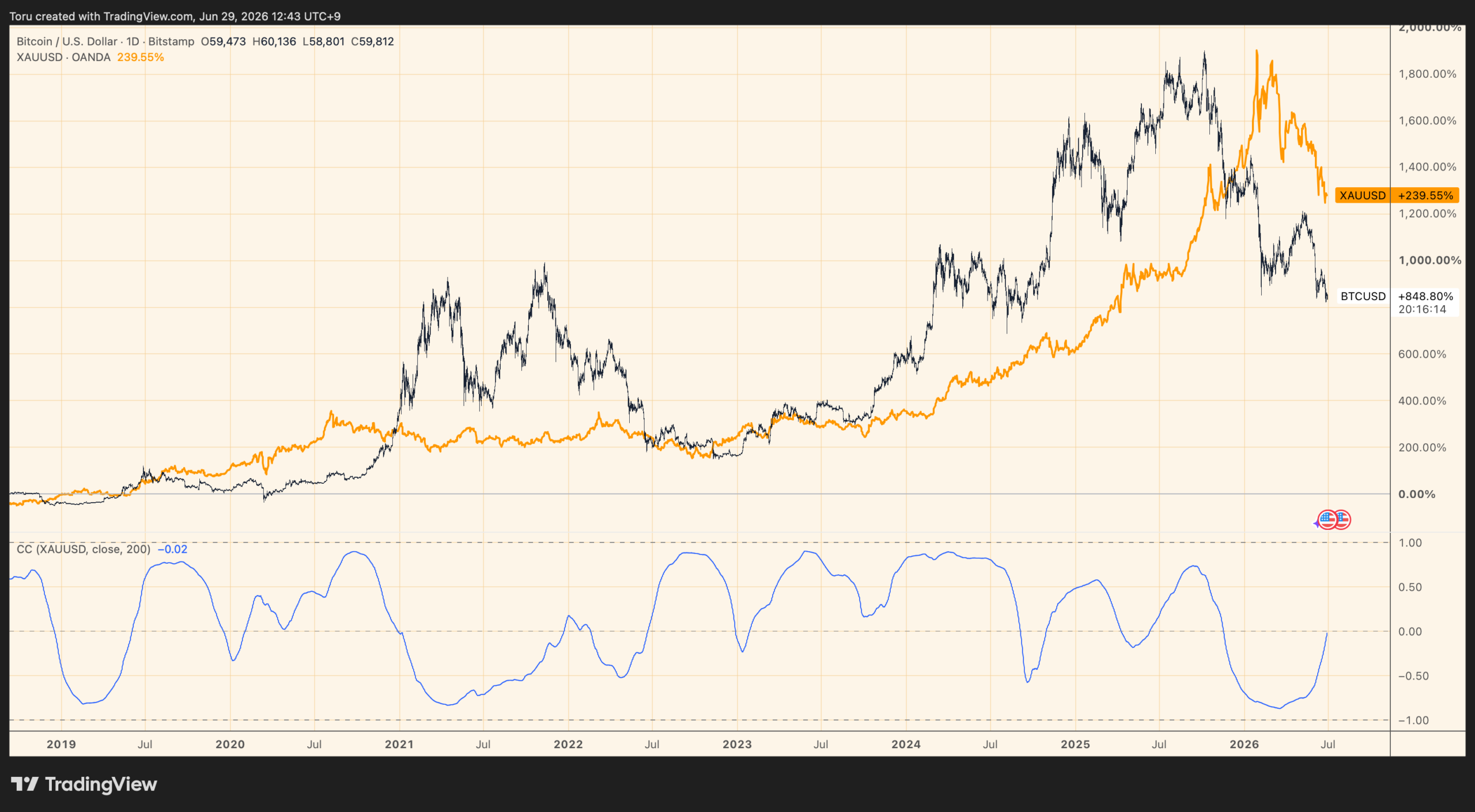
Gold — the thing Bitcoin is supposedly a digital copy of — moved the opposite way. Hard.
At the very moment Bitcoin acted like everything, it pulled away from the one asset it was named after.
Pull the lens back, and that strange spring stops looking like an exception.
It starts looking like the rule.
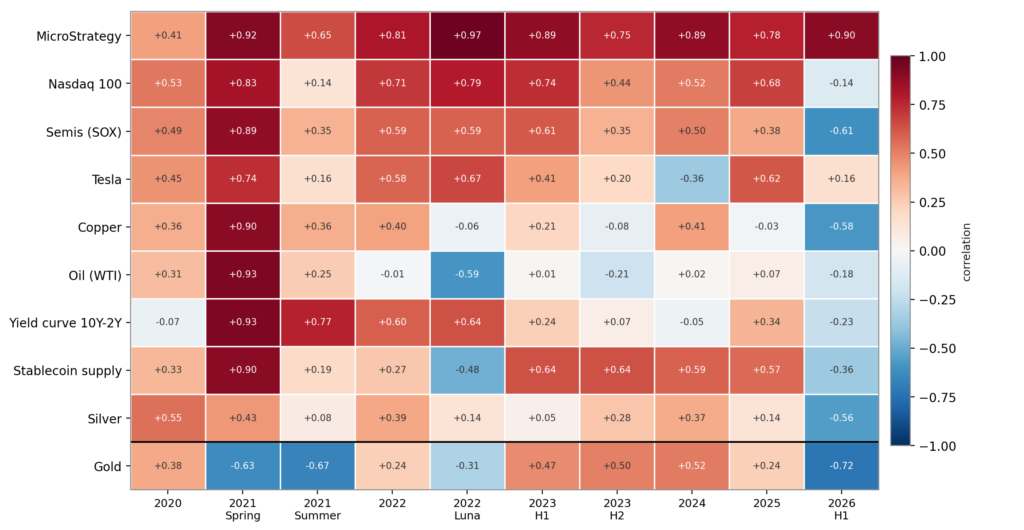
There’s no stable answer in this table.
The answer is the movement itself. And that restlessness shows up not just in how Bitcoin trades — but in what we keep calling it.
The labels are bets on what it moves with
Every few years, the world hands Bitcoin a new name.
Digital gold, or rat poison. Sound money, or electronic garbage. You name it — Bitcoin’s been called it.
Strip the tone off any of them and the same thing sits underneath: a guess about what Bitcoin moves with.
“Digital gold” bets it tracks gold. “Risk-on beta” bets it tracks the Nasdaq. “Rat poison” bets it tracks nothing real, and ends at zero.
A name for Bitcoin is just a bet about what it moves with — dressed up as a fact.
Which is why none of them stick.
The names keep changing for the same reason the correlations do: the thing being named is still becoming what it will be.
A finished asset has a fixed name and steady relationships. Gold has been gold for five thousand years.
Bitcoin is seventeen. It’s still working out who it runs with.
What follows is the same story, told twice. Once in the names people gave it. Once in the data underneath.
Watch how often the two disagree.
Act one: the years it held every hand (2020–2021)
Coming out of the COVID crash, Bitcoin grabbed whatever was rising.
In March 2020, the Federal Reserve promised to buy bonds in unlimited amounts. That broke the dam. Every risk asset took off at once.
Bitcoin’s tie to the Nasdaq, near zero for most of its life, snapped positive — and stayed there.
By early 2021, Tesla had put $1.5 billion into Bitcoin and Coinbase had listed on the Nasdaq. Bitcoin was now part of the risk-on family.
So it did what a young thing does in a new family. It held every hand in the room.
That’s the hold-everything phase. The name that stuck — “magic internet money” — caught it exactly.
Nobody was pretending this was a careful macro bet. It was simply the thing that went up when everything else did.
Act two: the twin it keeps pushing away
Here’s the relationship that should make a careful reader stop.
“Digital gold” is Bitcoin’s most flattering nickname. It’s also the one the data is least willing to back up.
For most of its life, Bitcoin’s tie to gold has sat near zero — or below.
And it turns most negative at exactly the wrong moment: when one of the two is having its big run.
In 2021, when Bitcoin was the story, gold moved against it.
In early 2026, when gold was the story — record highs, central banks buying, the world drifting off the dollar — the two pulled apart harder than they had in years. Down to -0.86 in March.
Two assets sold as twins. Behaving like siblings who can’t be in the same room.
Whenever the spotlight finds one, the other steps into the shadow.
Why?
Because they drink from different taps.
The buyer moving gold right now is the central bank — China, Turkey, India — stacking physical metal in their own currencies. Insurance against political risk and dependence on the dollar.
That money never touches the US dollar system.
Bitcoin’s price does the opposite. It lives and dies by dollar liquidity.
Same shelf in the “store of value” aisle. Completely different plumbing behind the wall.
When one tap runs dry, the other can keep flowing. Which is why “digital gold” keeps failing its own test.
Hold onto the plumbing. It’s where this whole story is heading.
Act three: walking alone (2026)
In 2026, the labels that had fit for years all came loose at once.
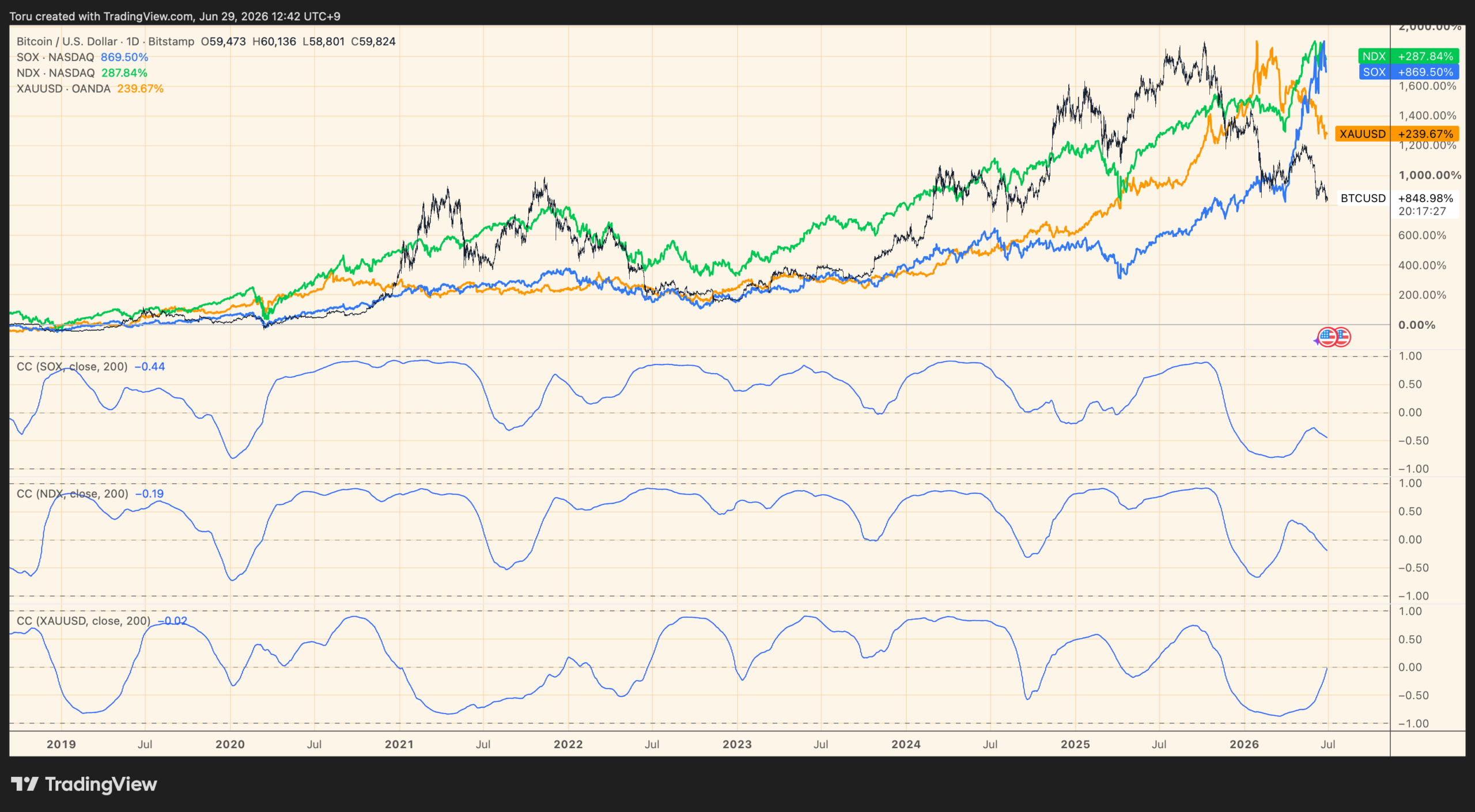
The Nasdaq tie went negative. Semiconductors, negative. Nvidia — the face of the whole risk-on era — flat to zero. Gold, negative too.
For the first time in a long while, Bitcoin wasn’t clearly “tech.” Wasn’t “risk-on.” Wasn’t “digital gold.”
The market has a name for this phase too, and it’s a telling one. Global liquidity barometer.
Not a bet on any asset. A bet on the tide that moves all of them.
For two years I tried to find the Bitcoin–Nasdaq correlation like it was a law.
It worked — until 2026, when it quietly went negative.
The relationship was never wrong. I just never asked how long it had signed for.
That’s what an asset looks like when it stops borrowing its identity from the company it keeps — and starts answering to something upstream of it all.
The marriage hidden in the data
If the story stopped there, the lesson would be simple: “Bitcoin holds onto nothing.”
And that would be wrong — in an important way.
One relationship only ever climbed. And never let go.
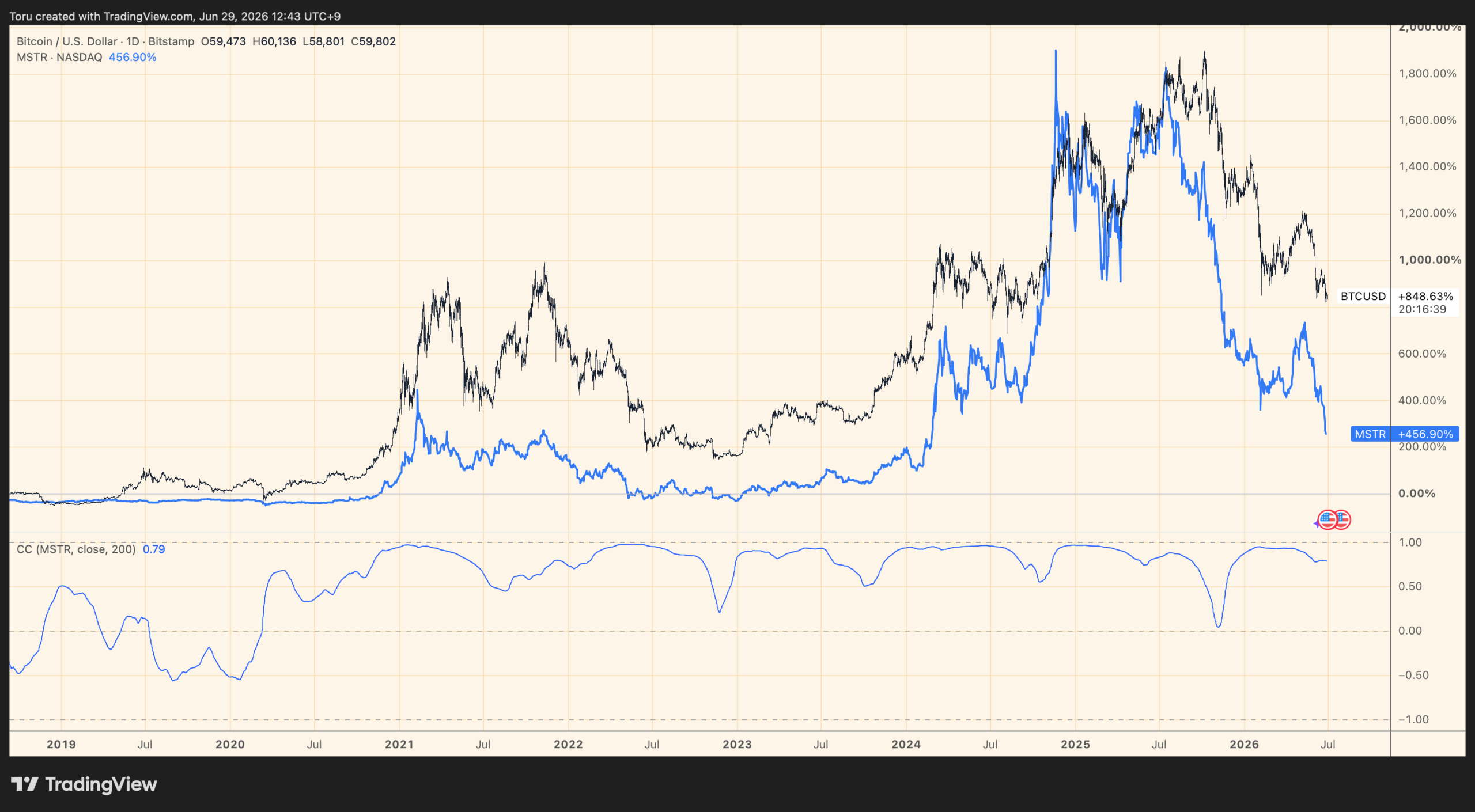
Back in 2017, MicroStrategy and Bitcoin barely moved together.
Then, in 2020, the company started putting Bitcoin on its balance sheet.
The tie went vertical. At the bottom of the 2022 crash, the two were +0.98 — effectively one asset. Years later, in 2026, still locked together.
That line doesn’t wander, because it isn’t a mood. It’s a balance sheet.
Corporate adoption, stamped — literally — into the data.
So the right reading isn’t “nothing sticks.”
It’s that two kinds of relationship run at once.
The ones that come and go are the market’s opinion of the week. Risk-on, risk-off, whatever’s hot.
The ones that lock in and stay are structural. Real adoption. Real plumbing. Hardening underneath the noise.
The skill isn’t picking which asset Bitcoin “really” tracks.
It’s spotting which bonds are setting — and which are about to evaporate.
“But isn’t that just a polished way to say ‘no anchor’?”
Fair objection.
Isn’t “its correlations keep shifting because it’s growing” just a flattering way to say “it’s a speculative asset with nothing underneath”?
On the surface, the two look identical. Both produce a number that won’t sit still.
The difference is in the shape of the motion.
A speculative asset with nothing underneath produces noise — links that flicker at random and mean nothing.
What Bitcoin produces is migration.
A link forms. Holds for one era. Hands off to the next. And underneath it all, the structural bonds only harden.
Noise has no memory and no direction. Migration has both.
One is a coin flip, repeated. The other is an asset working out where it belongs.
What actually holds
If both the names and the numbers keep moving, then chasing “what is Bitcoin tracking now” is a treadmill.
By the time a label feels obvious, the market has already moved to the next one.
The one relationship that has never really broken isn’t with an asset at all.
It’s with the tide beneath all of them — the rise and fall of dollar liquidity.
It was the dam breaking in 2020. It’s the different tap that lets gold and Bitcoin pull apart. It’s what a “global liquidity barometer” is really reading.
Stop trying to name Bitcoin’s partner. Start watching the water level.
And a lot of the chaos starts to look like signal.
Which brings us back to where we started.
A fixed correlation and a permanent name — those would be the two clearest signs that Bitcoin had finished growing. That it had settled into a fixed seat in the system.
Look at the data. That day plainly hasn’t come.
Its refusal to hold still isn’t the asset’s weakness.
In fourteen years of data, it might be the most bullish line on the page.
Bitcoin Geekend — macro & liquidity reads on Bitcoin. Nothing here is investment advice; it’s a way of looking.