Energy Becomes Intelligence | Bitcoin Is Not Finished — Ep. 5
🎧 LISTEN TO THIS ESSAY
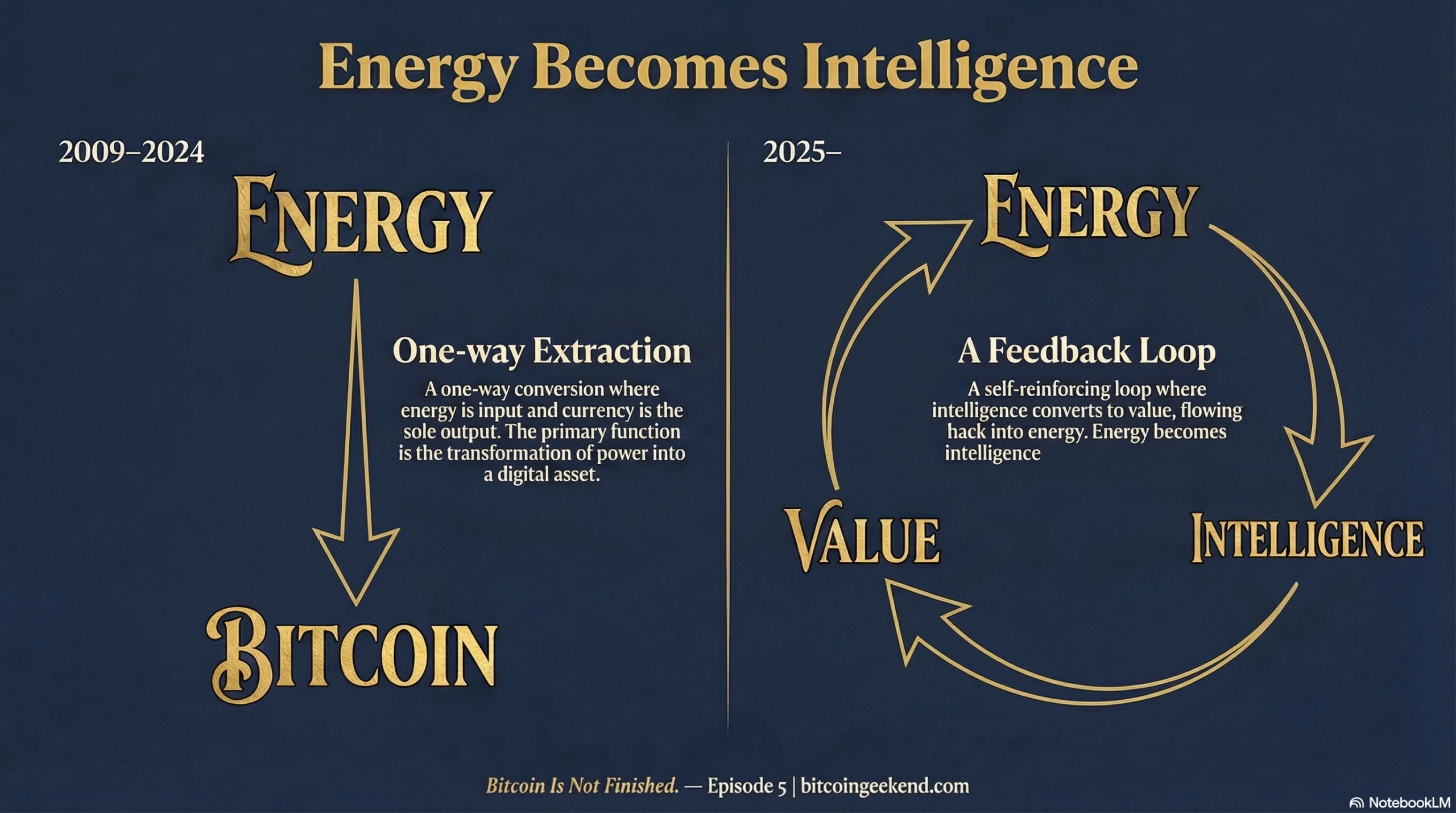
There’s a technology that turns electricity into money. You already know what it is. Bitcoin mining takes energy — raw kilowatt-hours — and converts it into a globally tradable asset. Plug in a machine, solve a math problem, receive Bitcoin. Energy in, currency out.
This conversion has a fascinating property: it’s geography-agnostic. The math problem doesn’t care where you solve it. A kilowatt-hour in Texas solves the same hash as a kilowatt-hour in Kazakhstan. So the miners who win are the ones with the cheapest electricity. Always. This is why mining operations cluster around stranded energy — hydroelectric dams in rural China, geothermal vents in Iceland, flared natural gas in North Dakota. Energy that has nowhere else to go becomes the most competitive input.
For fifteen years, this one-way conversion — energy to currency — was the only game in town.
That’s changing.
A second conversion is emerging, and it may turn out to be far more consequential. Instead of turning energy into currency, it turns energy into intelligence. AI inference. Model training. Image generation. Data processing. Every time an AI agent thinks — every time it processes a query, generates a response, renders an image, or trains on new data — it consumes GPU cycles, and GPU cycles consume electricity.
The economics are identical to mining. The AI workload doesn’t care where the GPU is located. A floating-point operation in Virginia produces the same result as one in Novosibirsk. So the providers who win are the ones with the cheapest electricity. The same geographic logic that drove Bitcoin mining is now driving AI compute.
But here’s where it gets different — and, I think, more important.
Mining is a one-way street. Energy goes in, Bitcoin comes out. The miner sells the Bitcoin. Transaction complete.
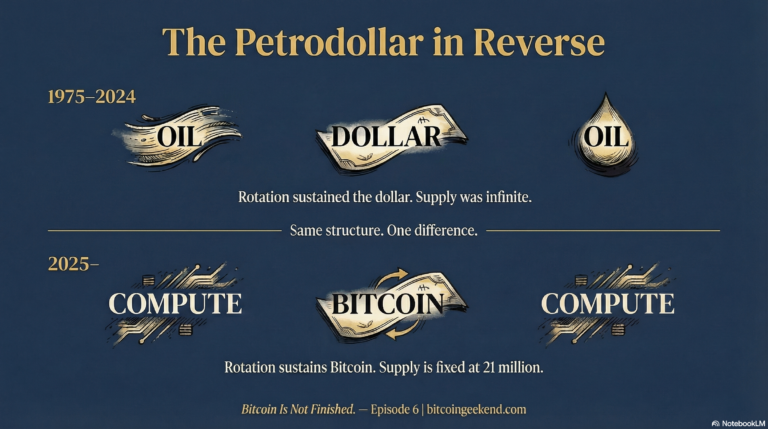
AI compute is a loop. An AI agent buys GPU time to perform inference. It uses the result to provide a service — maybe it translates a document, generates a video, analyzes a dataset. The client pays the agent. The agent uses that payment to buy more compute. Energy becomes intelligence, intelligence becomes value, value buys more energy. A cycle. A rotation.
This rotation is new. And it changes the economics of everything we discussed in the last episode.
In Episode 4, I argued that AI agents would choose Bitcoin through a process of elimination — no operator, no rollbacks, no single point of control. But I left a question unanswered: where would this AI compute actually come from?
The answer is already taking shape. A new category of platform — decentralized GPU marketplaces — is aggregating idle graphics processors from around the world and selling compute to anyone who needs it. Gaming PCs sitting idle at night. Workstations in universities. Retired mining rigs repurposed for inference. The model is simple: if you have a GPU, you can rent it out. If you need a GPU, you can rent one. No contract with Amazon. No negotiation with Google Cloud. Just a marketplace where compute is priced by the laws of supply and demand.
The cost savings are not marginal. They’re dramatic — fifty to eighty percent cheaper than centralized cloud providers, depending on the workload. And the market is growing fast. The AI inference market alone was valued at roughly $106 billion in 2025 and is projected to reach $255 billion by 2030.
Now, each of these platforms has its own token. Call them what you want — utility tokens, governance tokens, payment tokens. The point is, if you want to buy compute on Platform A, you pay in Token A. Platform B requires Token B. Platform C, Token C.
An AI agent doesn’t care about platform loyalty. It cares about cost, speed, and reliability. So it will hop between platforms constantly, chasing the best price for each task. It finishes a job on Platform A, receives Token A as payment, and immediately needs to buy compute on Platform B. Token A is useless on Platform B.
What does the agent do? It converts. But to what?
It could convert to Token B directly. But the liquidity between Token A and Token B is thin — it’s like trying to exchange Kazakhstani tenge for Peruvian soles. The spread will eat the profit.
It could convert to a stablecoin. Liquid, stable, accepted everywhere. But stablecoins have operators. Tether can freeze wallets. Circle complies with sanctions. For an AI agent optimizing for reliability, any asset that a third party can freeze is a risk.
Or it could convert to Bitcoin. No operator. No freeze risk. The deepest liquidity of any cryptocurrency. The most trading pairs. The widest acceptance across platforms and jurisdictions.
For an AI agent hopping between platforms across borders at machine speed, Bitcoin becomes the intermediate currency — not because anyone mandated it, but because the chaos of competing tokens creates a structural need for a common settlement layer. The same way the U.S. dollar became the intermediate currency for international trade — not because every country loved America, but because converting yen to reais directly was impractical, while yen to dollars to reais always worked.
Now add one more layer.
Some of the cheapest energy on Earth is in countries under Western sanctions. This is not a coincidence. When a country is cut off from global energy markets, it can’t sell its oil or gas abroad. The energy has nowhere to go. Prices collapse domestically. Iran generates electricity at $0.002 per kilowatt-hour — the lowest rate in the world — because international sanctions prevent it from exporting its vast natural gas reserves.
That cheap energy is already being converted. Iran legalized Bitcoin mining in 2019, and its on-chain economy reached $7.78 billion in 2025. The country mines Bitcoin at roughly $1,320 per coin and sells it at market price. Stranded natural gas, converted to globally accepted value, without touching a single dollar or passing through a single bank. Russia launched a ruble-backed token in early 2025 that processed $93 billion in transactions in under a year — equivalent to a third of the country’s entire import bill.
Now imagine AI agents entering this picture. An agent needs GPU compute. It scans the global marketplace. The cheapest option is powered by stranded energy in a sanctioned jurisdiction. The agent wants to buy it. But it can’t pay in dollars — sanctions block the transaction. It can’t use a credit card — there’s no banking relationship. It can’t use a stablecoin — the issuer might freeze the wallet for sanctions compliance.
It can use Bitcoin.
Not because Bitcoin is better in some abstract philosophical sense. Because it’s the only payment rail that physically works across that particular border. The sanctions that were designed to protect dollar dominance have, as a side effect, created zones where only non-dollar instruments function. And the cheapest compute in the world is increasingly located inside those zones.
Here’s the irony. The United States enforces sanctions to protect the dollar’s position as the world’s reserve currency. But every new sanction expands the territory where dollars can’t operate. And as AI agents begin to optimize globally for the cheapest compute, they will inevitably route economic activity through those dollar-free zones — paying in the only currency that crosses every border without permission.
The empire defends its walls. The walls create shadows. And in the shadows, a different economy grows.
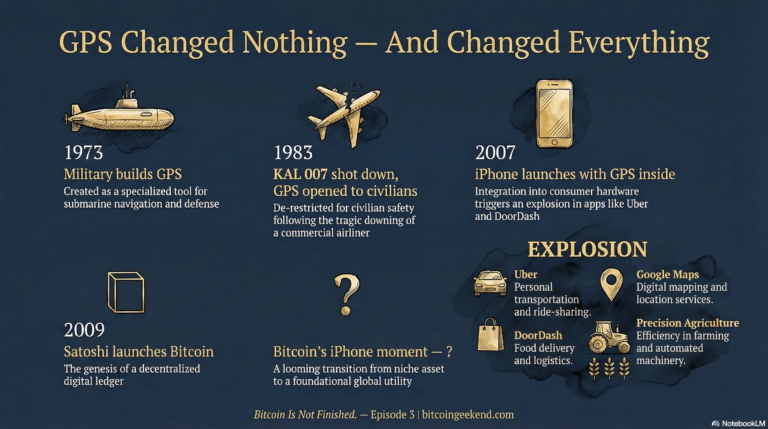
This is the same pattern we’ve seen in every episode of this series. Gutenberg printed Bibles to serve the Church. The press destroyed the Church’s monopoly. GPS was built to protect American submarines. It destroyed taxi monopolies on American streets. Sanctions are enforced to protect the dollar. They may be building the infrastructure for the dollar’s successor.
Nobody plans these outcomes. Nobody sees them coming. The people building decentralized GPU marketplaces today are trying to make AI compute cheaper. They are not trying to create a global settlement layer for machine intelligence. The engineers optimizing inference on cheap energy are not trying to reshape monetary systems. But the conditions are converging. And when they do, the result won’t be what any of us predicted.
The question isn’t whether AI will need a currency. It will. The question is what happens when billions of agents start rotating value through a fixed-supply asset at machine speed — not because they believe in it, not because they’re hoarding it, but because the math works and nothing else does.
That’s what we’ll explore next.
Bitcoin is not finished.
Bitcoin Is Not Finished is a series exploring what Bitcoin might become — not through price charts or market analysis, but through the patterns humans have repeated across 6,000 years of technological history. New episodes publish twice weekly.
Also available on Apple Podcasts and YouTube.