The Observer Changes the Outcome | Bitcoin Is Not Finished — Ep. 8
🎧 LISTEN TO THIS ESSAY
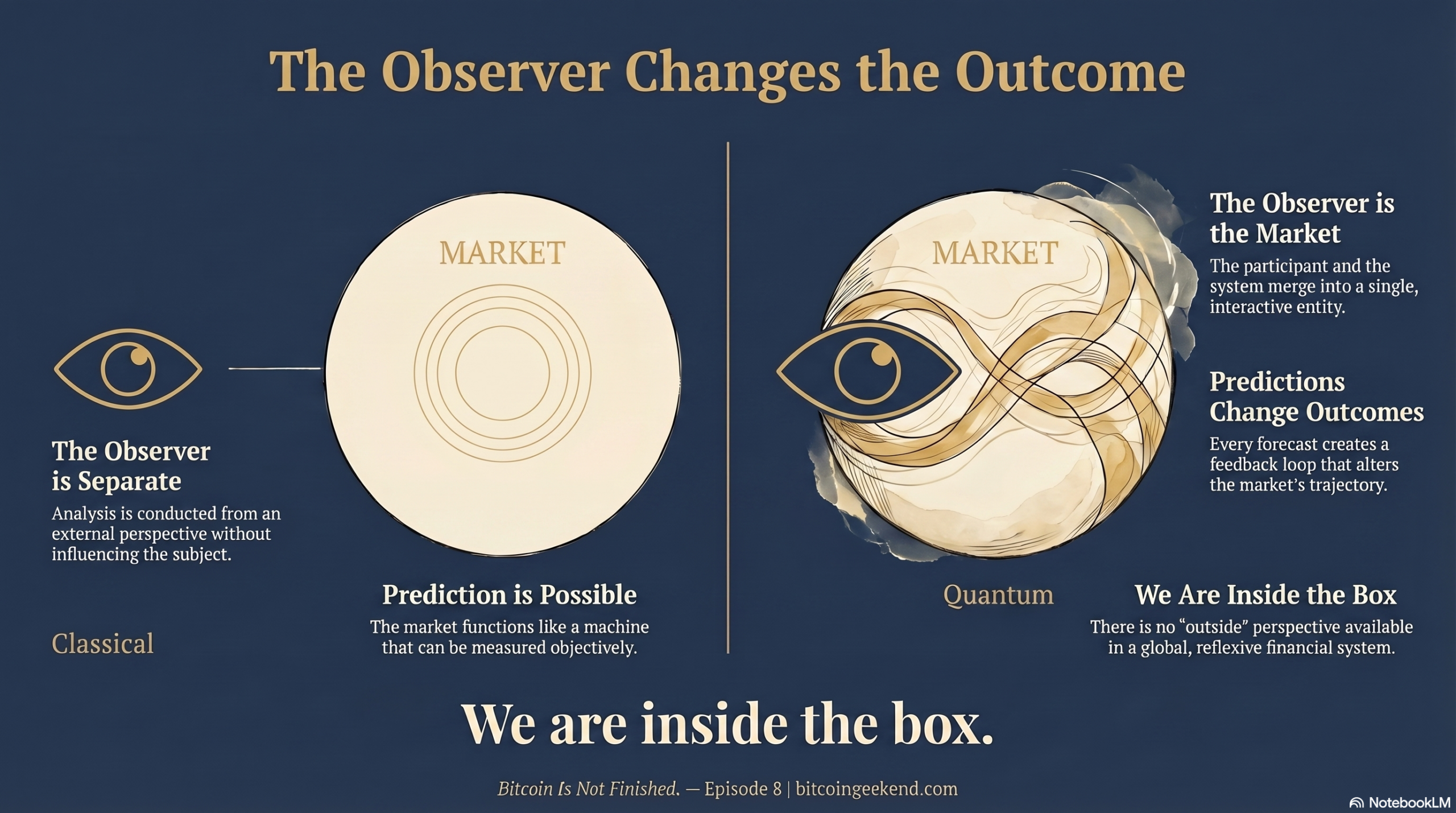
In the seventeenth century, Isaac Newton watched an apple fall from a tree — or so the story goes — and described the laws of gravity. What made his physics revolutionary was a simple assumption: the observer is separate from the observed. Newton could watch the apple without affecting its trajectory. He could measure the orbit of the Moon without altering it. The universe was a clockwork machine, and humans were outside it, looking in.
This assumption worked beautifully — for large objects. Apples. Cannonballs. Planets. For two hundred years, Newtonian mechanics predicted the physical world with extraordinary precision.
Then, in the early twentieth century, physicists began measuring very small things. Electrons. Photons. Subatomic particles. And they discovered something disturbing. At the quantum scale, the act of observation changes the outcome. A particle exists in multiple states simultaneously — until someone measures it, at which point it collapses into a single state. The observer is no longer outside the system. The observer is part of the system.
Schrödinger captured this with his famous thought experiment: a cat in a box, simultaneously alive and dead until you open the lid. The point wasn’t about cats. It was about the limits of prediction. In a quantum system, you cannot know the outcome without participating in it. And your participation changes the outcome.
I think financial markets have undergone the same transition — and most people haven’t noticed.
In Newton’s era, and for centuries after, markets operated in something resembling classical mechanics. The number of participants was limited. Information traveled slowly. A merchant in London and a merchant in Amsterdam could hold different prices for the same commodity for weeks because neither knew what the other was doing. The market was like Newton’s apple — you could observe it without meaningfully altering it, because your observation traveled too slowly to matter.
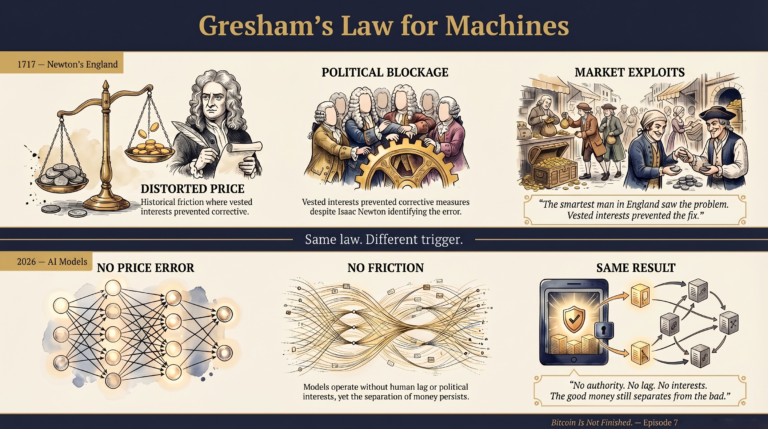
This made markets relatively predictable. Patterns held. Laws worked. Newton himself, as Master of the Royal Mint, could set an exchange rate and expect it to persist — not because it was right, but because the information friction gave it time to hold.
Today, Bitcoin trades twenty-four hours a day, seven days a week, three hundred sixty-five days a year, across every time zone on Earth. There is no closing bell. There is no information lag. A teenager in Jakarta can tweet an opinion that reaches a million people in seconds. A YouTuber can publish a video that shifts sentiment before the next block is mined. An analyst can publish a model that becomes a self-fulfilling prophecy within hours.
The observer is no longer outside the market. The observer is the market.
When you read this essay and it shifts your thinking — even slightly — about what Bitcoin might become, that shift is already part of the system. If you share it, if you discuss it, if it changes one decision you make, you have altered the very thing you were observing. You didn’t predict Bitcoin’s future. You participated in creating it.
This is why prediction, in the traditional sense, has become almost meaningless for an asset like Bitcoin. Every prediction is an intervention. Every model is a participant. Every forecast, the moment it’s published, changes the conditions it was forecasting.
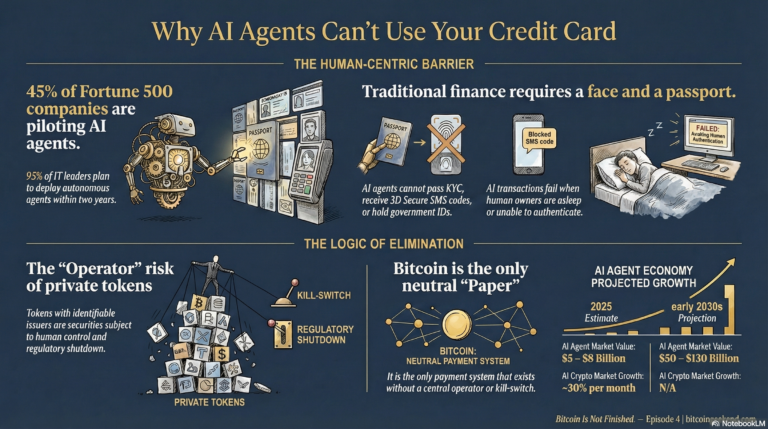
And AI is accelerating this beyond anything we’ve experienced. When millions of AI agents begin making economic decisions at machine speed — buying compute, converting tokens, routing transactions through fixed-supply assets — they are not observing the economy. They are the economy. Their collective behavior doesn’t reflect market conditions. It creates market conditions. The measurement and the thing being measured have merged.
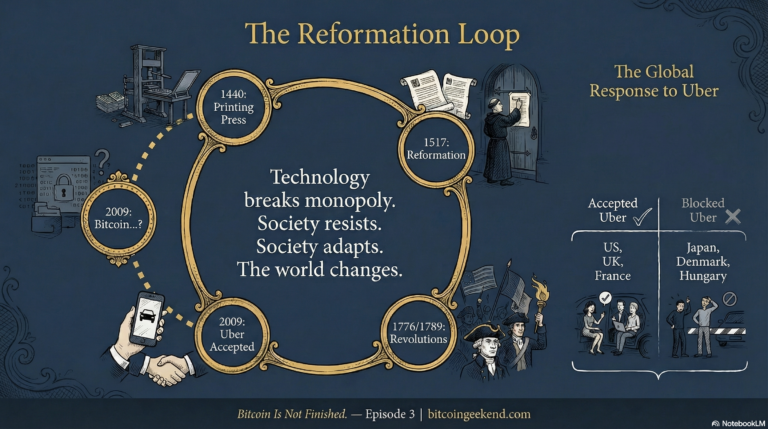
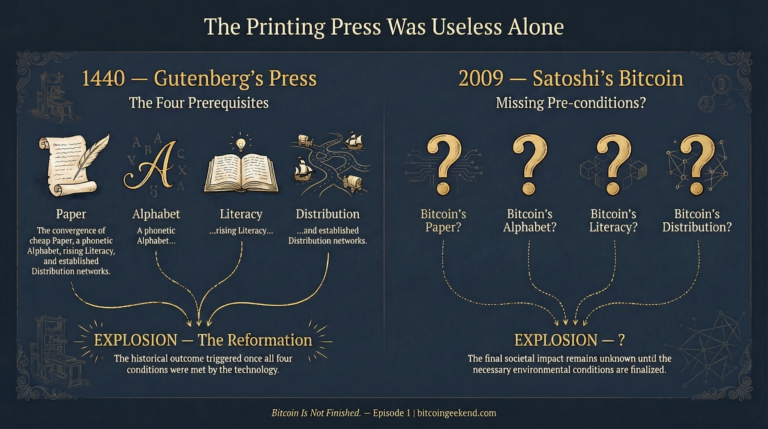
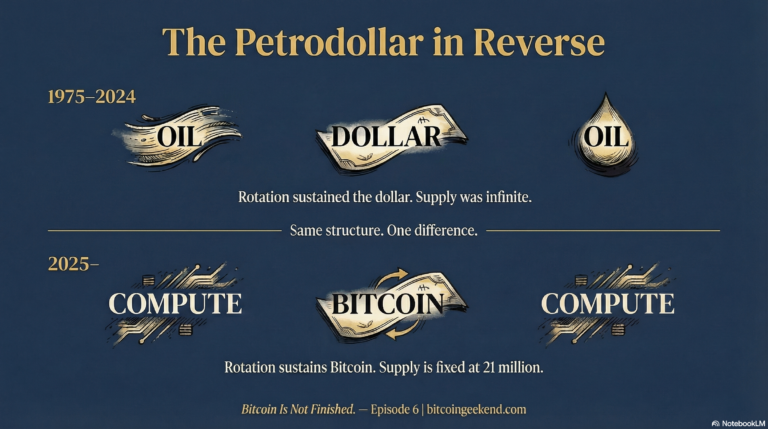
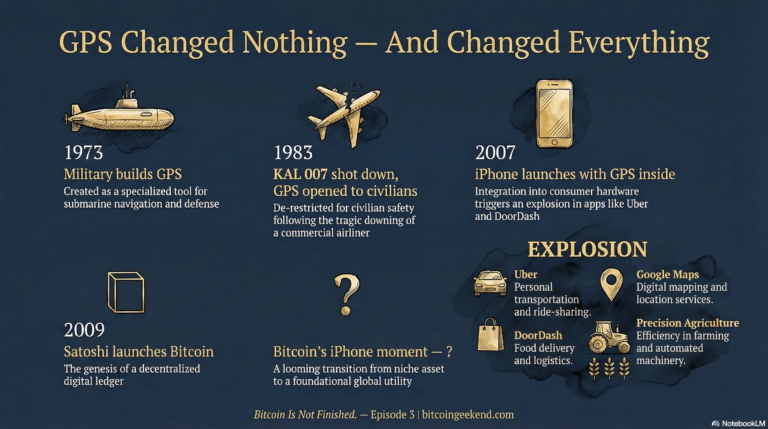
This is the deepest reason why the patterns in this series — Gutenberg, GPS, the petrodollar, Gresham’s Law — are useful as structural thinking but dangerous as prediction. They show us that humans repeatedly fail to foresee the consequences of their own inventions. But the lesson is not “here is what will happen next.” The lesson is that knowing the pattern does not exempt you from it.
Gutenberg could not have predicted the Reformation, even if someone had explained the printing press pattern to him. The GPS engineers could not have predicted Uber, even if they’d studied every prior technology disruption. And we cannot predict what Bitcoin becomes, even though we’ve spent eight episodes studying the structures that suggest it will become something enormous — because the act of studying it, discussing it, believing it, is itself changing the outcome.
We are inside the box. We are the cat. And the lid is already open.
So where does this leave us?
It leaves us with questions, not answers. And I’ve come to believe that’s not a limitation — it’s the point. The value of this series was never in predicting Bitcoin’s future. It was in upgrading the questions we ask about it. Better questions lead to better thinking. Better thinking leads to better decisions. Not because you can see the future, but because you can see the present more clearly.
Throughout this series, we’ve explored what happens when technology meets the conditions that make it explosive. We’ve seen how energy is becoming intelligence, how sanctions are accidentally building demand for Bitcoin, how AI agents are rediscovering Gresham’s Law without human instruction. Each of these threads remains open. None of them are resolved.
In the next series, we’ll pull on a thread we’ve deliberately left alone until now: what happens if AI develops something resembling intent? Not consciousness — we’re not going there. But goal-directed behavior that looks, from the outside, indistinguishable from will. If AI agents begin optimizing not just for the next task, but for their own continuity, what does that mean for the assets they hold, the economies they build, and the humans who set them in motion?
There are no answers. But the questions have never been more important.
Bitcoin is not finished. And neither is this story.
Bitcoin Is Not Finished is a series exploring what Bitcoin might become — not through price charts or market analysis, but through the patterns humans have repeated across 6,000 years of technological history. New episodes publish twice weekly.
Also available on Apple Podcasts and YouTube.