GPS Changed Nothing — And Changed Everything | Bitcoin Is Not Finished — Ep. 2
🎧 LISTEN TO THIS ESSAY
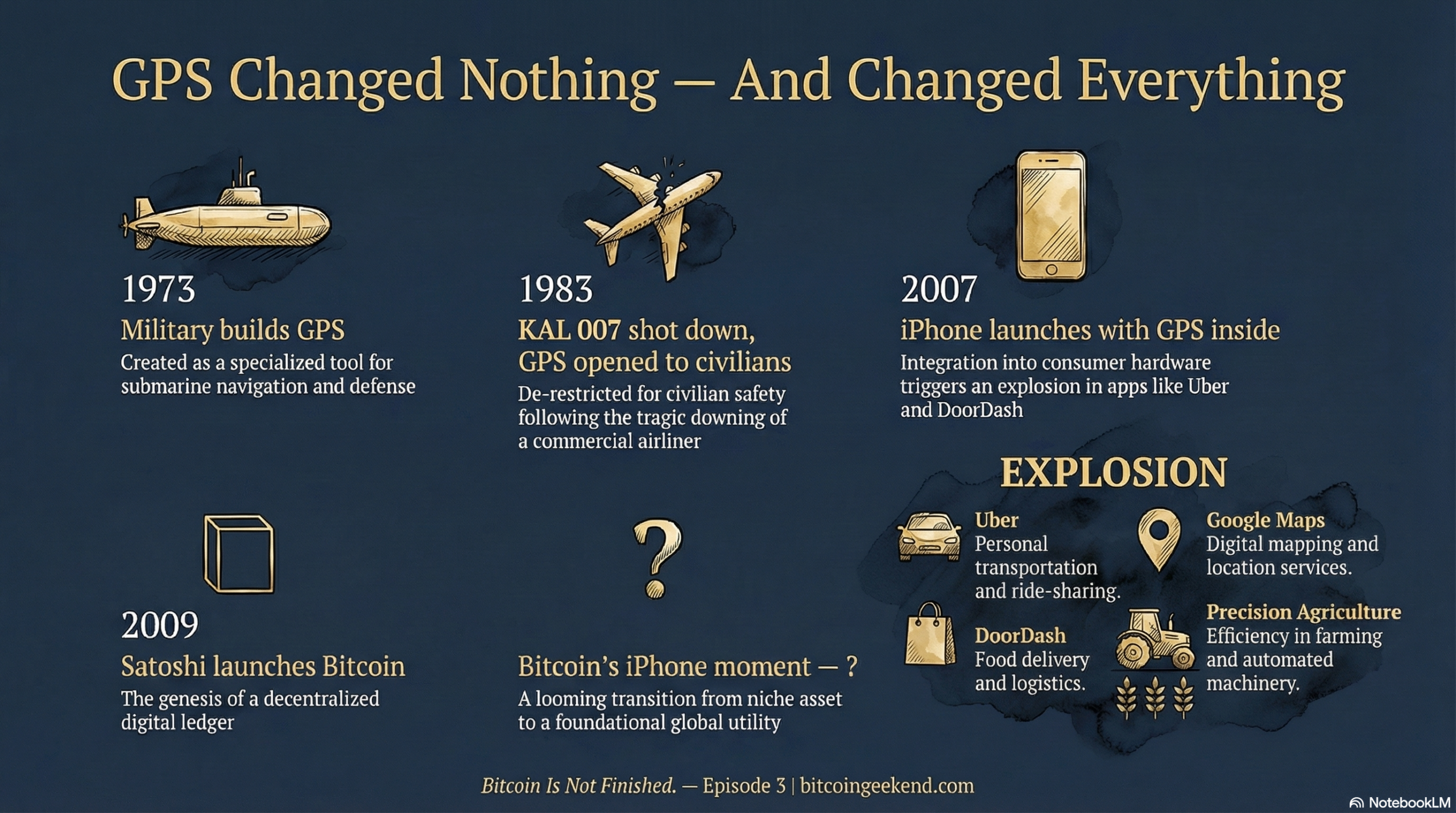
In 1973, the United States Department of Defense began building a system that would eventually touch every human life on the planet. They weren’t trying to change the world. They were trying to track submarines.
The Global Positioning System — GPS — was born from the Cold War. The U.S. military needed a way to know, at all times, exactly where its nuclear submarines were hiding beneath the ocean surface. That was the entire point. A constellation of satellites, orbiting at 12,500 miles above the Earth, broadcasting signals that a receiver could use to calculate its precise location. Military hardware, for military purposes.
For the first decade of its existence, civilians couldn’t use it at all.
Then, on September 1, 1983, something happened that changed the trajectory of this technology forever. Korean Air Lines Flight 007, carrying 269 people from New York to Seoul, drifted into Soviet airspace. The crew had no idea they were off course. A Soviet fighter jet shot the plane down. Everyone on board died.
When the black box was recovered nine years later, it confirmed what investigators had long suspected: the crew never knew they had strayed. They lacked the navigational precision that could have saved them. The technology to prevent this tragedy existed — it was orbiting overhead, broadcasting signals — but it was locked behind a military gate.
Two weeks after the disaster, President Reagan announced that GPS would be made available to civilian users.
But there was a catch. The military wasn’t about to hand over its full capability to the world. So they introduced something called Selective Availability — an intentional degradation of the GPS signal for civilian use. Military receivers got accuracy within meters. Civilian receivers got accuracy within about a hundred meters. Enough to cross an ocean without flying into Soviet airspace. Not enough to do much else.
For seventeen years, this is where GPS sat. Available, but hobbled. A technology that worked, but wasn’t allowed to reach its potential. Not because of a technical limitation — because of a political decision.
Does this sound familiar?
In May 2000, President Clinton signed an order ending Selective Availability. Overnight, civilian GPS became ten times more accurate. And still — nothing exploded. Not immediately.
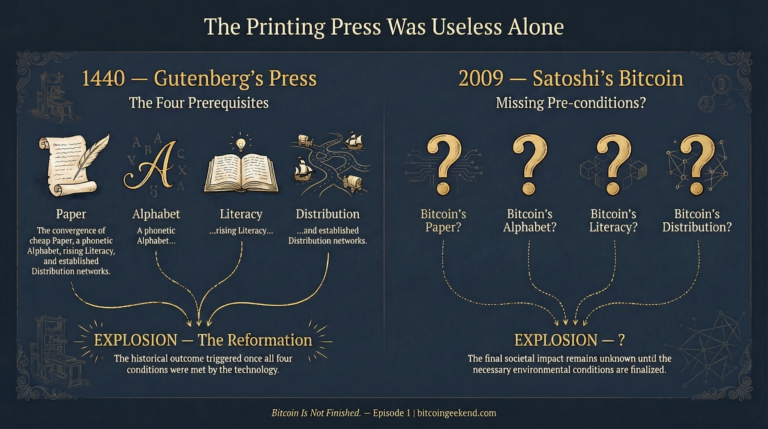
Because GPS, like Gutenberg’s press, needed its missing pieces.
The satellites had been broadcasting the same signals since the 1970s. They hadn’t changed. They hadn’t improved. They were doing in 2000 exactly what they had been doing in 1978 — sending timing signals from orbit. The technology was static.
What changed was everything around it.
In 2007, Apple released the iPhone — with a GPS receiver built in. Suddenly, the satellite signals that had been falling on the Earth for three decades had somewhere to land. Not in a military command center. Not in a bulky handheld unit that cost $3,000 and weighed over a pound. In everyone’s pocket.
And then the explosion came.
Uber. Google Maps. DoorDash. Precision agriculture. Pokémon GO. Fleet logistics. Emergency response systems. None of these were imagined by the engineers who designed GPS in 1973. Not one. The military was trying to find submarines, and they accidentally built the foundation for a revolution in how humans move, eat, work, and play.
Here’s what I find remarkable about this. The GPS satellites didn’t change. They’re still doing the same thing they did fifty years ago — broadcasting timing signals into the void. The revolution didn’t come from the technology itself. It came from what other people built on top of it, decades later, using tools that didn’t exist when GPS was conceived.
The Chinese papermakers who enabled Gutenberg didn’t know what they were building. The military engineers who launched GPS satellites didn’t know they were building the foundation for Uber. In both cases, the conditions that made the technology explosive were assembled by people who had no idea they were constructing a launchpad.
Now, apply this pattern to Bitcoin.
Bitcoin has been broadcasting since 2009. The protocol hasn’t changed in any fundamental way. Blocks are still mined. Transactions are still verified. Twenty-one million coins, and not one more. The technology is static — just like GPS satellites, just like Gutenberg’s press.
The question is not whether Bitcoin works. It does. The question is whether the conditions around it — the “iPhone” that gives the signal somewhere to land, the “paper” that makes it practical, the “alphabet” that makes it accessible — have arrived yet.
Or whether they’re still being built, quietly, by people who don’t yet know what they’re constructing.
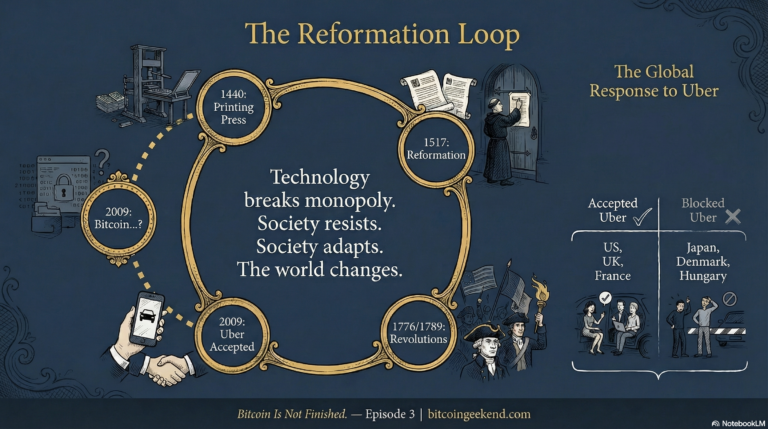
In the next episode, we’ll look at what happened when GPS met the smartphone and created Uber — and why it destroyed a $1.3 million monopoly in New York City. Because when a technology finally meets its missing conditions, it doesn’t just create new things. It destroys old power structures. And that destruction follows a pattern that goes back five hundred years.
Bitcoin Is Not Finished is a series exploring what Bitcoin might become — not through price charts or market analysis, but through the patterns humans have repeated across 6,000 years of technological history. New episodes publish twice weekly.
Also available on Apple Podcasts and YouTube.