The Printing Press Was Useless Alone | Bitcoin Is Not Finished — Ep. 1
🎧 LISTEN TO THIS ESSAY
Most people think the printing press changed the world the moment Gutenberg built it.
It didn’t.
The idea of pressing symbols onto a surface is older than most civilizations. In ancient Mesopotamia, cylinder seals were rolled across wet clay to stamp patterns and text — a kind of proto-printing that dates back thousands of years before Christ. The concept was there. The instinct to duplicate information was there. But nothing exploded.
Then, somewhere around the 11th century, a Chinese inventor named Bi Sheng created movable type. Individual characters carved into ceramic pieces that could be rearranged and reused. This was, on paper, a revolutionary leap. You no longer had to carve an entire page from a single block. You could compose, print, disassemble, and recompose.
But it went nowhere.
Why? Because Chinese uses thousands of characters. Arranging and managing that many ceramic pieces was so labor-intensive that the efficiency gains collapsed under the weight of the language itself. The hardware was right. The software — the language — wasn’t compatible.
This is worth pausing on. A genuinely brilliant technology, invented by a genuinely brilliant person, failed to ignite — not because the technology was flawed, but because the surrounding conditions weren’t ready.
Fast forward to Europe, 1440s. Gutenberg builds his press. And within decades, the world cracks open. Books pour out. Ideas spread. The Catholic Church loses its monopoly on scripture. Martin Luther nails his theses to a door, and within a generation, the entire political and spiritual order of Europe is rewritten.
So what was different? What did Europe in 1450 have that China in 1040 didn’t?
The answer is not one thing. It’s several, and none of them were invented by Gutenberg.
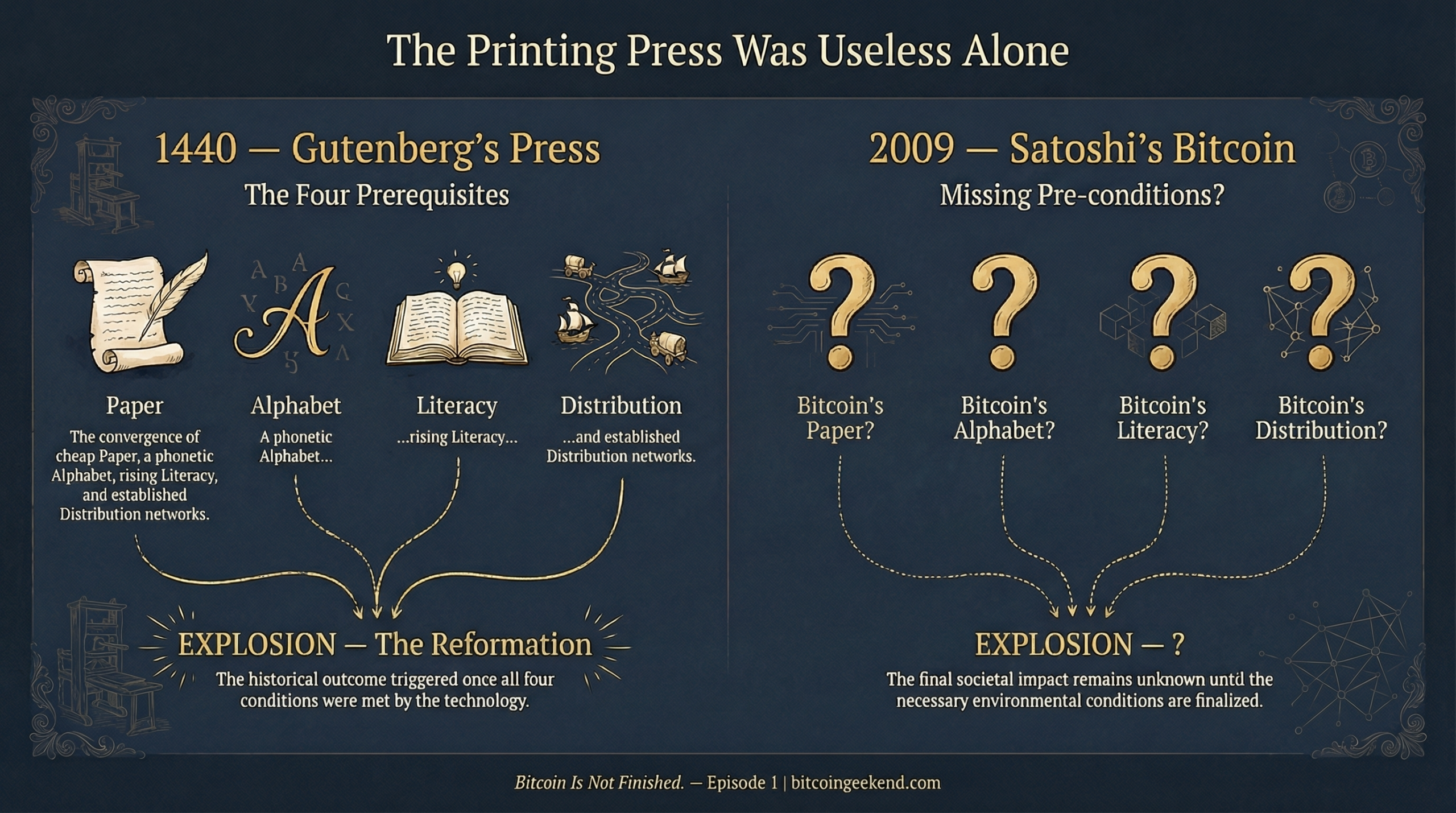
The alphabet. Latin script uses 26 letters. Twenty-six movable pieces to compose any word in the language. Compare that to the thousands required for Chinese characters. The alphabet was a compression technology — it made movable type practical in a way that was simply impossible with logographic writing systems. Gutenberg didn’t invent the alphabet. It had been around for millennia. But without it, his press was just a machine.
Paper. Papermaking originated in China, traveled through the Islamic world over centuries, and arrived in Europe around the 13th century. Before paper, Europeans wrote on parchment — animal skin, expensive and scarce. Paper dropped the cost of the output medium dramatically. Gutenberg didn’t invent paper. But without cheap paper, there was nothing affordable to print on.
Literacy. By the 15th century, Europe’s urban population was growing. Universities were expanding. Merchants, craftsmen, and administrators increasingly needed to read. There was a rising class of people who could consume printed material — and who wanted to. Gutenberg didn’t create literacy. But without readers, there were no customers.
Distribution networks. Trade routes, market towns, and an emerging merchant class provided the infrastructure to move printed books from workshop to buyer. Gutenberg didn’t build the roads. But without distribution, books sat in warehouses.
Here’s what strikes me about this. Every single condition that made the printing press explosive was developed independently, by people who had no idea they were building the launchpad for a revolution. The Chinese papermakers didn’t know they were enabling Gutenberg. The monks teaching Latin in monasteries didn’t know they were creating a market for printed bibles. The merchants building trade networks didn’t know they were building a distribution system for ideas that would topple the Church’s authority.
Nobody planned this. The conditions converged. And when the final piece — Gutenberg’s press — dropped into place, the reaction was immediate and irreversible.
Now, here’s why I’m telling you this.
I believe Bitcoin is the printing press.
Not the finished product. Not the revolution itself. The printing press — sitting in Gutenberg’s workshop in 1440, waiting for conditions that haven’t fully materialized yet.
Bitcoin was born in 2009. It’s been ignored, mocked, declared dead hundreds of times, and celebrated as the future of money. Seventeen years in. And I think we’re still in the equivalent of Gutenberg printing his first Bible — impressive, but nowhere near the real impact.
Because Bitcoin, like the printing press, doesn’t operate in isolation. It needs its own “paper” — a cost-effective medium that makes it practical for everyday use. It needs its own “alphabet” — a simplification layer that makes it accessible to people who don’t understand cryptography. It needs its own “literacy” — a critical mass of people who not only can use it, but want to. And it needs its own distribution network — infrastructure that moves value as effortlessly as trade routes moved books.
Some of these conditions may already be forming, built by people who have no idea they’re constructing the launchpad for something much bigger. Just as the papermakers of Damascus didn’t know they were enabling the Reformation.
What are those conditions? What is Bitcoin’s “paper”? Who is building it right now without realizing what they’re building?
I have a hypothesis. But I’ll save that for the next episode.
For now, I want to leave you with one thought. Bi Sheng invented movable type four hundred years before Gutenberg. The technology existed. It worked. But the world wasn’t ready. Four centuries passed before the conditions caught up.
Bitcoin has been here for seventeen years. The technology exists. It works. But what if the world isn’t ready yet — and the conditions that will make it explode are still being assembled, quietly, by people who don’t yet know what they’re building?
Bitcoin Is Not Finished is a series exploring what Bitcoin might become — not through price charts or market analysis, but through the patterns humans have repeated across 6,000 years of technological history. New episodes publish twice weekly.
Also available on Apple Podcasts and YouTube.